Guide
A Family Member Has Died in France: A Step-by-Step Guide for UK Families
A loved one has died in France and you're not sure what to do next? This step-by-step guide for UK families explains the immediate priorities after a death, introduces the French succession process, and directs you to the essential guides covering probate, notaries, property, inheritance tax, documents and estate administration.
When a family member dies in France, it can be difficult to know what to do first.
Whether you are already in France or have received the news while at home in the UK, you are suddenly faced with unfamiliar legal procedures, practical arrangements and decisions that may feel overwhelming.
The good news is that you do not need to solve everything at once.
This guide is designed to act as your starting point. It explains the overall journey and points you towards the detailed guides that will help you complete each stage of the process.
Important: This guide is intended for UK families dealing with a death in France. Every estate is different, and the exact process will depend on the deceased’s circumstances, assets and family situation.
Your First Priorities
During the first few days, focus only on the immediate practical matters.
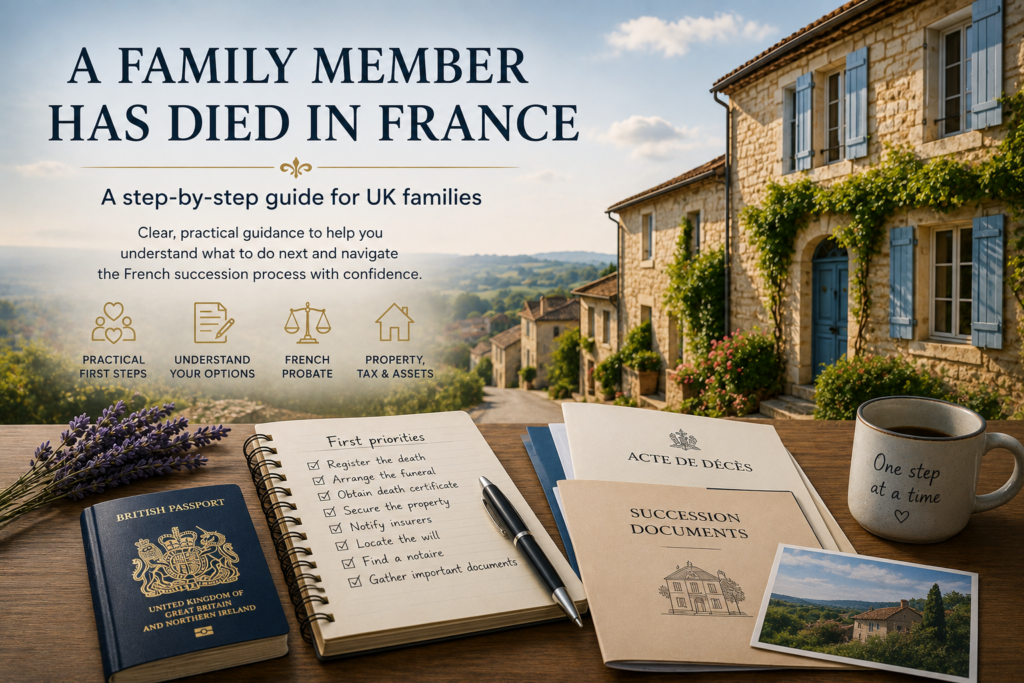
These typically include:
- registering the death in France;
- arranging the funeral or repatriation;
- obtaining copies of the French death certificate;
- securing any French property;
- notifying close family members; and
- locating the deceased’s important paperwork.
Do not worry if you cannot answer every legal question immediately. Most of the succession process happens over several months.
Secure the Estate
Once the immediate arrangements have been made, your next priority is protecting the estate.
This may include securing property, ensuring insurance remains valid, protecting valuables, locating keys and identifying any urgent maintenance that may be required.
Understand Who Is Responsible
Many families assume that obtaining probate in the UK automatically allows them to deal with French assets.
In reality, England and France have different legal systems, and responsibilities may be shared between the UK executor, the French heirs and the French notary.
Understanding who is responsible for what early on can prevent significant delays later.
Begin the French Succession
The French succession process is separate from UK probate and should generally begin as soon as reasonably possible.
A French notary will often need to identify the heirs, establish the estate, prepare the necessary legal documents and deal with inheritance tax and property transfers.
Start Gathering Documents
One of the biggest causes of delay is missing paperwork.
The French notary may request documents relating to the deceased, every heir and, where applicable, trusts, wills and previous marriages.
Rather than attempting to gather everything immediately, work through the document guides one by one.
Identify the Estate
Once the succession has begun, you’ll need to establish exactly what the deceased owned, together with any debts and ongoing financial commitments.
This often includes property, bank accounts, pensions, vehicles and insurance policies.
Understand the Tax Position
Cross-border estates may involve both UK and French tax considerations.
It is important not to assume that paying tax in one country automatically removes obligations in the other.
Dealing with Property
French property often requires separate legal formalities before it can be transferred or sold.
Understanding these requirements early can save considerable time later in the administration.
Special Situations
Some estates involve additional legal considerations, particularly where there are trusts, no will or requests for documents that do not exist in the UK.
Final Thoughts
Every French succession is different, but almost every family follows the same broad journey:
- Deal with the immediate arrangements.
- Protect the estate.
- Appoint the right professionals.
- Gather the required documents.
- Understand the UK and French legal procedures.
- Complete the succession and tax formalities.
- Transfer or distribute the estate.
You do not need to become an expert overnight.
Take each stage one at a time, work through the relevant guides, and don’t be afraid to seek professional advice where your circumstances require it.