Guide
Do I Need a French Avocat or a Notaire? Understanding the Difference
French notaires and avocats are both legal professionals, but they do very different things. This guide explains when you need a notaire, when you may need an avocat, and how to find a registered French lawyer.
One of the most common points of confusion for UK families dealing with a French succession is the difference between a notaire and an avocat.
Both are legal professionals, but they do not perform the same role.
In simple terms:
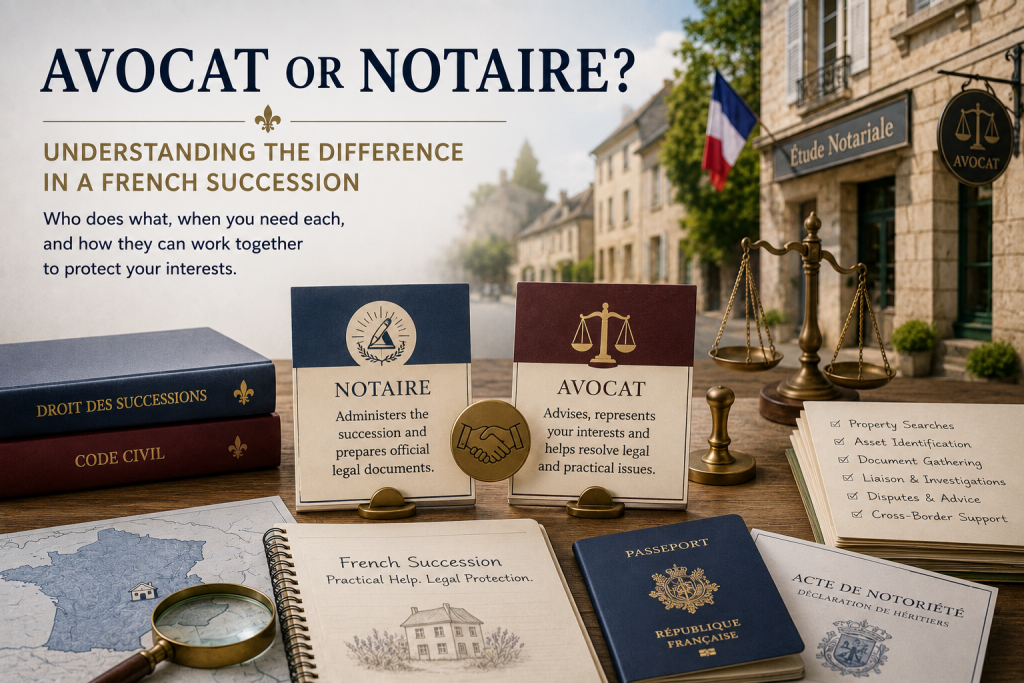
- A notaire administers the succession and prepares official documents.
- An avocat advises and represents your interests, especially where there is a dispute or legal complexity.
Understanding the difference can help you know who to contact, what to expect and when you may need independent legal advice.
What Does a Notaire Do?
A French notaire is a public legal officer.
In a succession, the notaire is usually responsible for:
- Identifying the heirs.
- Preparing the Acte de Notoriété.
- Gathering information about the estate.
- Preparing succession documents.
- Calculating French inheritance tax.
- Dealing with French property transfers.
- Preparing official notarial deeds.
- Liaising with tax authorities and land registry offices.
If the deceased owned French property, a notaire will almost always be required.
A notaire is not simply the French equivalent of a UK solicitor. Their role is more formal and administrative, particularly where property and succession documents are involved.
What Does an Avocat Do?
An avocat is closer to what a UK person would usually think of as a lawyer or solicitor.
An avocat can:
- Give independent legal advice.
- Represent your interests.
- Advise on disputes.
- Communicate with other legal professionals.
- Assist with complex legal questions.
- Help where you disagree with the notaire’s approach.
- Advise on court proceedings if needed.
An avocat works for you as their client.
This is an important distinction.
A notaire may be responsible for administering the succession, but an avocat can advise you personally if you need someone clearly acting in your interests.
When Might You Need an Avocat?
Many straightforward successions can be completed using only a notaire.
However, in practice, many families—particularly those managing a succession from outside France—find that an avocat provides valuable practical assistance that goes beyond simply giving legal advice.
You may wish to instruct an avocat if:
- There is a dispute between heirs.
- You disagree with the notaire’s interpretation of the law.
- The succession involves trusts or complex UK legal issues.
- You need advice on Brussels IV or which country’s succession law applies.
- Assets are missing or difficult to locate.
- You need help communicating with French organisations.
- You are unable to spend significant time in France.
- You want someone acting solely in your interests throughout the succession.
In our own succession, our avocat proved invaluable in helping investigate the estate, communicating with local organisations and assisting with practical matters that fell outside the work our notaire was prepared to undertake.
Every succession is different, and the level of assistance provided by individual professionals can vary considerably.
An Avocat Can Also Help With Practical Investigations
Although an avocat’s primary role is to provide legal advice and represent your interests, many are also willing to assist with practical investigations during a succession.
Depending on the circumstances, an avocat may be able to help:
- Request land transaction searches to help identify properties owned by the deceased.
- Liaise with local businesses, such as mechanics, garages or storage facilities.
- Communicate with banks, insurance companies and other organisations where appropriate.
- Help obtain or interpret documents.
- Correspond with the notaire on your behalf.
- Explain French legal procedures in plain English.
- Coordinate with your UK solicitor where cross-border issues arise.
This can be particularly valuable if you live in the UK and cannot easily travel to France.
In many successions, the notaire’s role is focused on preparing the legal acts required to administer the estate. While some notaires will actively assist in gathering information and contacting organisations, others will expect the heirs to obtain much of this information themselves.
An avocat can often bridge that gap by helping you carry out the investigations needed to identify assets, gather documents and resolve practical issues before the succession can move forward.ested or unclear, an avocat can provide independent advice and protect your position.
Can an Avocat Replace a Notaire?
Usually, no.
An avocat cannot normally replace the notaire’s role in preparing formal notarial deeds, transferring French property or completing the official succession paperwork.
Instead, the avocat works alongside the process.
Think of it this way:
| Professional | Role |
|---|---|
| Notaire | Administers the succession and prepares official legal deeds. |
| Avocat | Advises and represents your interests. |
In many cases, you may need both.
Finding a French Avocat
The best place to start is the official national directory maintained by the Conseil National des Barreaux (CNB).
The CNB directory lists registered avocats in France and allows you to search by location, name and other criteria. It states that it contains the contact details of 78,938 avocats in France as of 1 January 2026.
Official directory:
https://cnb.avocat.fr/annuaire-des-avocats-de-france
Using Consultation Avocat
Another useful official service is Consultation Avocat.
This allows you to find an avocat and arrange different types of consultation, including in-person appointments, video consultations, telephone callbacks and written questions.
Official service:
https://consultation.avocat.fr
This can be particularly useful if you need initial advice but are not yet ready to formally instruct a lawyer.
Searching by Local Bar Association
Every avocat belongs to a local barreau, or Bar Association.
You can search by the relevant local bar if you know where the succession or property is located.
For example:
- Barreau de Lorient
- Barreau de Rennes
- Barreau de Nantes
- Barreau de Paris
The CNB also maintains an official directory of French bar associations, listing 164 barreaux in France.
Directory of French Bar Associations:
https://cnb.avocat.fr/annuaire-des-barreaux-francais
What to Search For
If you are using Google, useful French search terms include:
- Avocat succession
- Avocat droit des successions
- Avocat succession internationale
- Avocat héritage
- Avocat droit international privé
- Avocat succession Franco-Britannique
- Avocat succession anglais France
You can combine these with the town or region.
For example:
- Avocat succession Lorient
- Avocat droit des successions Bretagne
- Avocat succession internationale Paris
Questions to Ask Before Instructing an Avocat
Before agreeing to work with an avocat, ask:
- Do you deal with succession law?
- Do you have experience with UK–France estates?
- Do you speak English?
- Can you advise on Brussels IV or choice of law issues?
- Can you work with my French notaire?
- What are your fees?
- Do you charge hourly or fixed fees?
- Can you provide an initial written summary of your advice?
- What documents do you need from me?
Do not be afraid to ask about fees early.
Legal advice can be extremely useful, but you should understand the likely cost before proceeding.
What Documents Should You Prepare?
Before speaking with an avocat, gather:
- Death certificate.
- Will.
- Marriage certificate.
- Divorce certificate, if applicable.
- Birth certificates of heirs.
- Any correspondence from the notaire.
- Property documents.
- Trust documentation, if relevant.
- UK solicitor correspondence.
- Any questions you want answered.
Sending clear documents and a short written summary can save time and reduce costs.
Useful Email Opening
You could write:
Bonjour,
Je recherche un avocat en droit des successions pour m’aider dans le cadre d’une succession franco-britannique. Le défunt résidait en France et certains éléments de la succession concernent également le Royaume-Uni.
Pourriez-vous me confirmer si vous avez de l’expérience dans ce type de dossier et si vous seriez disponible pour une première consultation ?
Cordialement,
In English:
Hello,
I am looking for a succession lawyer to assist with a UK–France succession. The deceased lived in France and some aspects of the estate also involve the United Kingdom.
Could you please confirm whether you have experience with this type of matter and whether you would be available for an initial consultation?
Kind regards,
Final Thoughts
A notaire and an avocat are not interchangeable.
The notaire manages the official succession process, while an avocat provides independent advice and can represent your interests if legal issues arise.
For straightforward successions, a notaire may be all you need.
But where there are disputes, trusts, unclear wills, cross-border legal issues or concerns about how the succession is being handled, an avocat can become an important source of independent support.