Guide
How to Find a Notaire for a French Succession
Choosing the right notaire is one of the most important decisions you'll make during a French succession. Learn how to find an experienced notaire for a UK–France estate, what questions to ask, and the warning signs that they may not be familiar with cross-border successions.
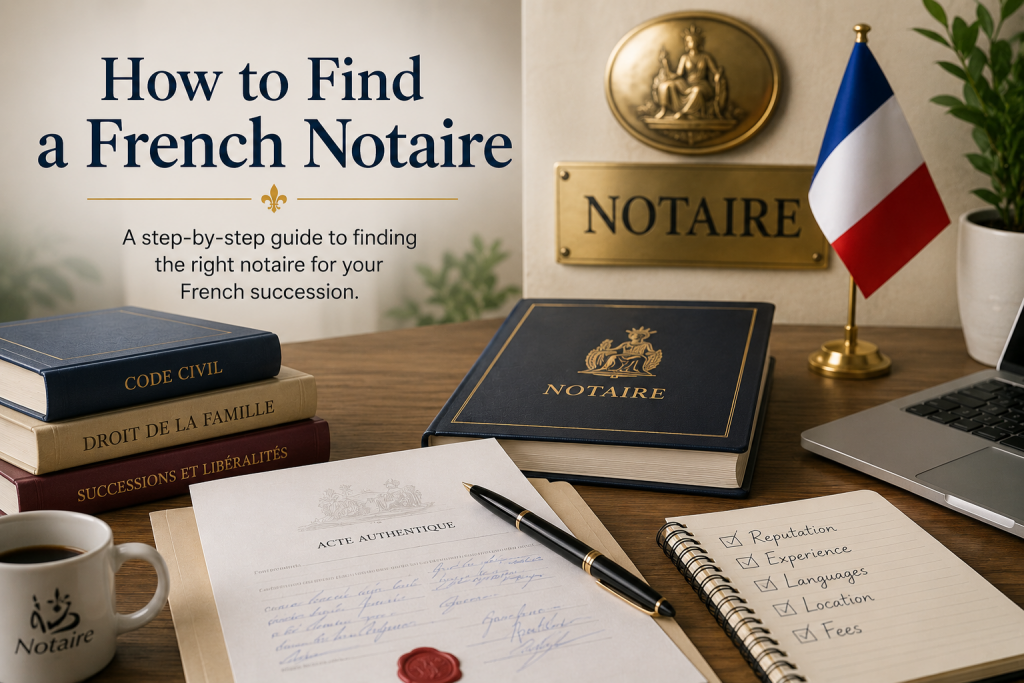
One of the most important decisions you’ll make during a French succession is choosing the right notaire.
At first, this might seem like the easiest part of the process. After all, every town in France has one or more notaires, and if your loved one already owned property in France, there’s a good chance they already had a notaire who handled the purchase or prepared their will.
Unfortunately, that doesn’t necessarily mean they’re the right person to handle a UK–France cross-border succession.
As we discovered ourselves, there’s a significant difference between a notaire who regularly deals with French property transactions and one who has experience navigating the additional complexities that arise when UK assets, trusts, probate and overseas beneficiaries are involved.
Start With the Existing Notaire
If your loved one already had a notaire, that’s usually the best place to begin.
They may have:
- Purchased the French property.
- Prepared the French will.
- Held copies of important documents.
- Already know the family and the estate.
Likewise, if there wasn’t an existing notaire, it makes sense to look for one local to the property. They’ll already be familiar with the local land registry, estate agents and other professionals that may become involved later.
Sometimes, this is all you’ll need.
Cross-Border Successions Are Different
Where UK beneficiaries or UK assets are involved, however, the succession quickly becomes more complicated.
Questions can arise around:
- UK probate.
- Certified translations.
- UK trusts.
- Certificates of coutume (or their UK equivalent).
- French inheritance tax.
- Double taxation.
- Communicating with solicitors in another country.
Not every notaire deals with these issues regularly.
Many offices primarily focus on buying and selling property, preparing wills, or handling straightforward French estates.
There’s absolutely nothing wrong with that—but it doesn’t necessarily mean they’ll have experience of an Anglo-French succession.
A Small Clue to Watch For
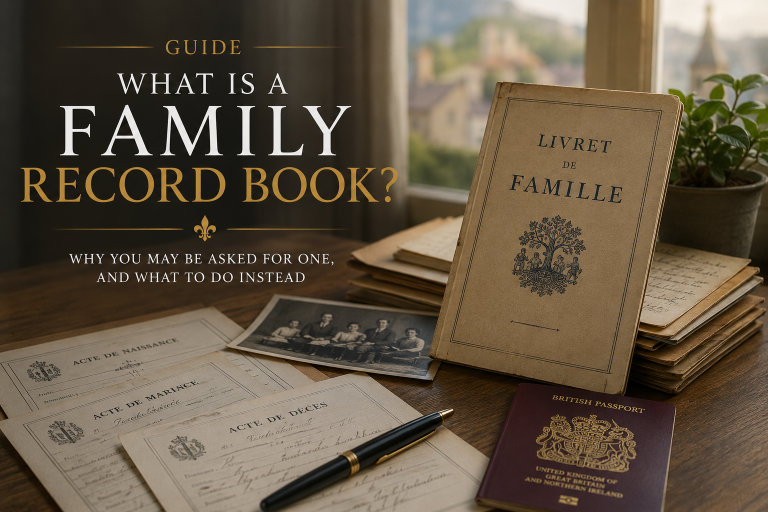
One thing we noticed during our own search was that some notaires immediately requested a Family Record Book (Livret de Famille).
For French families, that’s a perfectly reasonable request because it’s one of the primary documents used to establish family relationships.
For UK families, however, it’s different.
Most British families simply don’t have one.
An experienced notaire who regularly works with UK successions will usually know this and instead ask for birth certificates, marriage certificates, civil partnership certificates, divorce decrees and death certificates to establish the family tree.
If a notaire insists on a Family Record Book without recognising that UK families won’t normally have one, it may be an indication that they have limited experience dealing with cross-border successions.
It doesn’t necessarily mean they can’t handle your case—but it’s certainly worth asking about their experience with UK estates before proceeding.
If you’re unfamiliar with the Family Record Book, we’ve explained what it is, why French notaires ask for it, and what UK families should provide instead in our guide What Is a Family Record Book?
We Ended Up Looking Much Further Afield
Initially, we assumed we would simply use a local notaire.
In reality, finding someone with the right experience proved much more difficult.
Eventually, I turned to the official directory published by the Notaires de France, which allows you to search for notaires throughout France.
Rather than limiting my search to one town, I started looking across a much wider area for firms that specifically mentioned:
- Family law.
- Inheritance.
- Successions.
- International clients.
- English-speaking services.
I then visited each firm’s website before making contact.
This helped rule out offices whose work appeared to focus almost entirely on property transactions.
Don’t Be Surprised if You Contact Dozens
One thing that surprised me was just how many enquiries I ended up sending.
In total, I contacted more than 40 different notaires before finding one with the right combination of experience, availability and willingness to take on a complicated UK–France succession.
Some never replied.
Some politely declined.
Others admitted they didn’t deal with cross-border estates.
Eventually, however, I found a notaire who specialised in Anglo-French successions and immediately understood many of the issues we’d already spent months trying to explain elsewhere.
It was well worth the effort.
Prepare Your Documents Before Making Contact
One thing that made the process much easier was having a clear summary of the estate and supporting documentation ready to send.
Rather than exchanging multiple emails asking basic questions, prospective notaires could immediately understand:
- Who had died.
- Where they lived.
- Where the beneficiaries lived.
- Whether there was a French will.
- Whether UK assets were involved.
- Whether trusts existed.
- Which documents were already available.
This allows a notaire to quickly decide whether they’re able to assist.
We’ll cover exactly what to prepare in our guide Preparing Documents for Your French Notaire, including the key documents that can significantly speed up the initial assessment of your case.
What to Include in Your First Email
Keep your initial enquiry concise but informative.
Include:
- The deceased’s name.
- Date of death.
- The location of the French property.
- Whether there’s a French will.
- Whether the beneficiaries live in the UK.
- Whether UK probate or trusts are involved.
- Whether you’re looking for a notaire to take over an existing succession or begin a new one.
The aim isn’t to tell your whole story—it’s simply to allow the notaire to decide whether your case falls within their area of expertise.
Don’t Be Afraid to Change Notaires
Many families assume that once they’ve instructed a notaire, they’re committed to staying with them throughout the succession.
That’s not necessarily the case.
If progress has stalled, communication has broken down, or you believe the notaire doesn’t have the necessary experience to deal with your circumstances, it may be possible to transfer your file to another office.
We ultimately had to do exactly that.
Although it delayed matters slightly in the short term, finding a notaire experienced in UK–France cross-border successions made an enormous difference to our confidence that the estate was finally moving in the right direction.
Our Advice
If your succession is straightforward and entirely French, a local notaire may be all you ever need.
However, if UK beneficiaries, trusts, overseas probate or cross-border inheritance tax are involved, don’t be afraid to look beyond the nearest office.
Spend time researching firms, ask about their experience with Anglo-French estates, and don’t be discouraged if you need to contact a large number before finding the right one.
The right notaire won’t just process paperwork—they’ll understand the challenges unique to a UK–France succession and help guide you through what can otherwise become an incredibly complex process.
Finding that person may take a little longer, but in our experience, it’s one of the best investments of time you can make.