Guide
Can I Sign French Succession Documents from the UK?
If you're inheriting assets in France while living in the UK, you may not need to travel to sign succession documents. This guide explains when signatures can be completed remotely, when notarisation or an apostille may be required, and the practical steps to ensure your documents are accepted by your French notary.
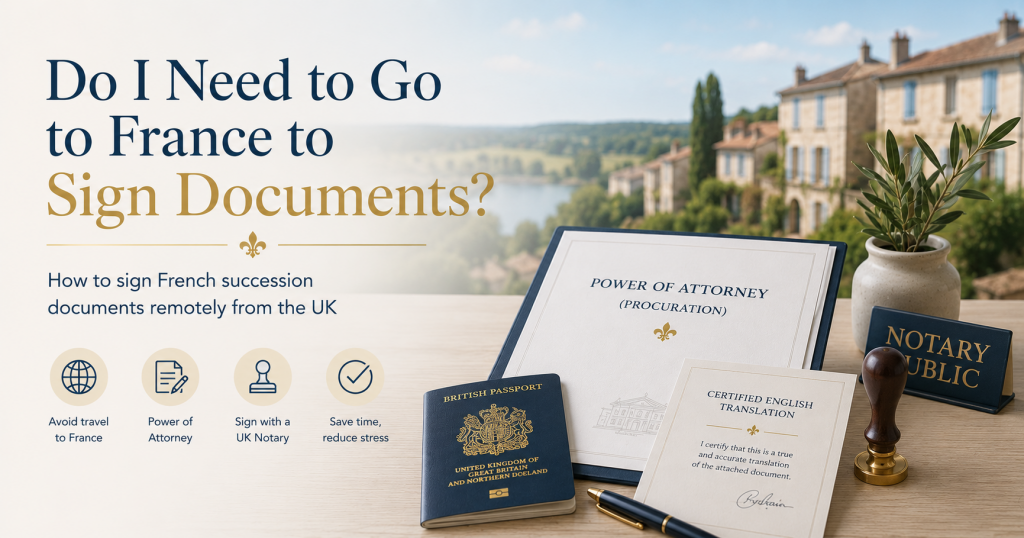
One of the questions many UK families ask when dealing with a French succession is whether every heir has to travel to France to sign paperwork in person.
The good news is that, in many cases, the answer is no.
While every succession is different and your notary will decide what is appropriate for your circumstances, it is often possible to complete much of the process remotely by giving your French notary a power of attorney (procuration).
How It Worked for Our Family
In our case, there were three heirs living in different parts of the UK. Travelling to France simply to sign succession documents would have been expensive, time-consuming and difficult to coordinate.
Instead, our French notary prepared a separate power of attorney for each heir.
These documents authorised the notary to sign the necessary succession paperwork on our behalf, including the Acte de Notoriété (Act of Notoriety) and later succession documents as the estate progressed.
Signing the Power of Attorney
Although we did not need to travel to France, we did still need to prove our identity and demonstrate that we understood the document we were signing.
In our case, the French notary prepared the power of attorney (procuration) in French. Before signing it, I arranged for it to be translated into English by a certified translator so that each heir could clearly understand the legal authority they were granting – this is generally a requirement of the French notary so do get it translated.
If you’re looking for a translator, see our guide on How to Translate UK Documents for France, where we explain how to find a certified translator and what to check before commissioning a translation.
Once we had both the French original and the certified English translation, each of us:
- Received both documents.
- Booked an appointment with a local UK notary public (Google, there are more than you think!).
- Read the English translation to ensure we fully understood the contents of the French document.
- Signed both the French original and the English translation in the presence of the UK notary.
- Had our identity verified by the UK notary, who certified that we had signed the documents and understood what we were signing.
- Posted the original signed documents back to the French notary in France.
Once the French notary had received the signed powers of attorney from each heir, they were able to sign the authorised succession documents on our behalf, meaning none of us had to travel to France simply to sign the succession paperwork.
Requirements can vary between notaries and individual successions, so always follow the instructions given by your own French notary before arranging translations, notarisation or postage.
Why This Can Be Helpful
For many families, heirs live in different towns, cities or even different countries.
Using a power of attorney can:
- Avoid multiple trips to France.
- Reduce travel costs.
- Make it easier to coordinate several heirs.
- Speed up the signing process once documents are ready.
- Allow the French notary to progress the succession without waiting for everyone to attend in person.
For our family, it meant that none of us had to travel to France simply to sign the succession paperwork.
Do You Always Need a UK Notary?
In our case, yes.
Our French notary required each power of attorney to be signed before a UK notary public so our identities could be verified before the documents were returned to France.
However, requirements can vary depending on the notary, the document being signed and your individual circumstances. Some documents may require additional formalities, while others may not.
Always follow the instructions provided by your French notary before arranging appointments or paying for certification.
Will the Power of Attorney Cover Everything?
Not necessarily.
A power of attorney normally specifies exactly which documents or transactions the French notary is authorised to sign on your behalf.
If additional documents arise later in the succession, your notary may prepare further powers of attorney if required.
Our Experience
Giving our French notary a power of attorney was one of the most practical decisions we made during the succession.
It allowed three UK-based heirs to complete the legal formalities without repeatedly travelling to France, while still ensuring our identities were properly verified and the documents were legally signed.
Every succession is different, but if you’re worried about having to travel to France simply to sign paperwork, it’s worth asking your French notary whether signing by procuration (power of attorney) is an option in your circumstances.