Guide
Why Am I Already the Owner of My Parent’s French Property?
Many UK families are surprised to discover they already own their parent's French property before they die. This guide explains how usufruct and bare ownership work in France, why this arrangement is common and what happens when the usufruct ends.
Understanding Usufruct (Usufruit) and Bare Ownership (Nue-Propriété)
One of the biggest surprises for many UK families dealing with a French succession is discovering that they already legally own their parent’s property.
It often comes as a shock.
The parent continued living in the house, paid the bills, maintained the property and perhaps even rented it out, yet the ownership documents show that the children have been the owners for years.
This isn’t a mistake.
It’s a very common French estate planning arrangement known as a donation with reservation of usufruct (donation avec réserve d’usufruit).
Understanding how this works can help explain why some French properties do not pass through the succession in the way many people expect.
The Two Parts of Ownership
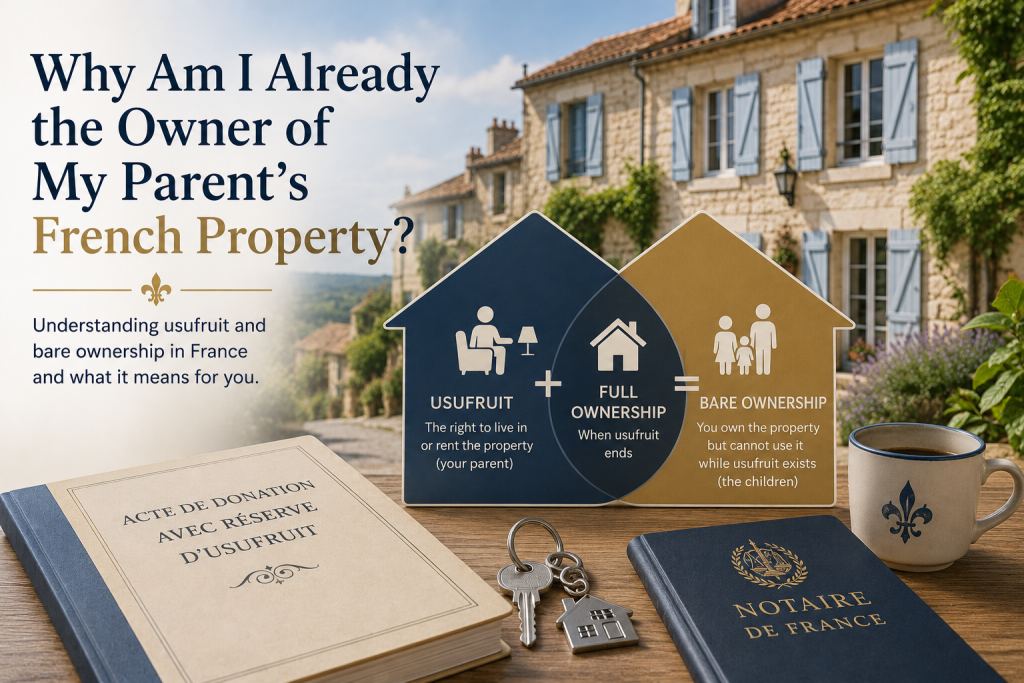
Unlike English law, French property ownership can be divided into two separate rights.
These are:
- Usufruit (Usufruct)
- Nue-Propriété (Bare Ownership)
Together they make up Pleine Propriété (full ownership).
Rather than one person owning everything, French law allows these rights to be split between different people.
What Is Usufruit?
A person who holds the usufruit has the legal right to enjoy the property.
This includes the right to:
- Live in the property.
- Rent it to someone else.
- Receive the rental income.
- Continue using the property throughout their lifetime.
However, they do not own the property’s capital value.
What Is Bare Ownership?
The bare owner (nue-propriétaire) owns the property itself but cannot fully enjoy it while someone else holds the usufruit.
In practice this means they usually cannot:
- Move into the property without agreement.
- Receive rental income.
- Prevent the usufruit holder from using it.
Instead, they become full owners once the usufruit ends.
Why Do French Families Use This Arrangement?
This type of ownership is very common in France.
Parents often transfer the bare ownership of a property to their children during their lifetime while keeping the usufruit.
This allows them to continue living in the home or receiving rental income while gradually passing ownership to the next generation.
It can also provide succession planning benefits under French law.
So Why Am I Already the Owner?
If your parent transferred the property in this way, you became the legal owner of the bare ownership on the day the donation was signed, not when they died.
Your parent simply retained the usufruit.
This means they continued to enjoy the property throughout their lifetime, while you already owned the underlying property rights.
What Happens When My Parent Dies?
When the usufruit holder dies, the usufruit automatically comes to an end.
You do not purchase the remaining interest.
Instead, your existing bare ownership and the extinguished usufruit combine to give you full ownership (pleine propriété).
In many cases, there is no further transfer of ownership required between parent and child because you already owned the property.
However, the notaire will still deal with the necessary legal formalities to update the French property records.
Does the Property Form Part of the Succession?
This is where many UK families become confused.
Although you may already own the property, it can still need to be considered as part of the succession for legal and tax purposes.
Exactly how this works depends on factors including:
- When the gift was made.
- Whether inheritance tax is due.
- The value of the usufruit.
- Other gifts made during your parent’s lifetime.
- The wider estate.
Every case is different, so your notaire will explain how it applies to your circumstances.
Can I Sell the Property Before My Parent Dies?
Generally, no.
While someone else holds the usufruit, the property rights are divided.
Selling the property usually requires agreement between both the usufruit holder and the bare owner.
This is because each person owns different legal rights over the property. Once the person has died however you can begin selling the property. You will need to acquire the deed of the property and death certificate of the deceased to prove the usufruit has ended, leaving you full ownership.
Who Is Responsible for Maintenance?
Responsibility for maintenance can sometimes be shared.
Major structural works and day-to-day maintenance may fall on different parties depending on the circumstances and the nature of the work.
If you already own the bare ownership, it is sensible to discuss responsibilities with the usufruit holder and, where necessary, seek advice from your notaire.
Securing the Property After Death
One practical consequence of this arrangement is that you may become responsible for securing the property immediately after the usufruit holder dies.
In my own family’s case, my brother already owned a French property through a usufruct arrangement.
Once the usufruit ended, it became essential to secure those properties without delay. We experienced problems with squatters attempting to gain access, and simply changing the locks was not enough—they later attempted to re-enter through other weaknesses in the buildings.
If you already own a property outright following the end of a usufruit, it is worth arranging for the property to be secured as soon as possible. This may include changing locks, checking windows and other entry points, and carrying out any necessary repairs.
Our guide on Finding a Handyman in France explains these practical steps in more detail.
How Is This Different from the UK?
This type of ownership has no direct equivalent in England and Wales.
While there are some similarities with life interest trusts, they are not the same legal concept.
Many UK families therefore find the arrangement confusing because ownership has effectively been divided between two people, each with different legal rights.
Common Misunderstandings
“The property wasn’t in the estate.”
Not necessarily.
Although ownership may already have been transferred, the property may still need to be considered during the succession.
“I only became the owner when my parent died.”
Usually not.
You often became the bare owner on the date the original donation was signed.
“The usufruit holder still owned everything.”
No.
The usufruit holder retained the right to use the property but not the full ownership.
“I can immediately do whatever I want with the property.”
Not while the usufruit still existed.
Only once the usufruit ends do you normally obtain full ownership rights.
Final Thoughts
Discovering that you already own your parent’s French property can initially be confusing, particularly if you’re familiar only with the UK legal system.
However, this arrangement is entirely normal in France and is widely used as part of family succession planning.
Understanding the distinction between usufruit, bare ownership and full ownership will help you better understand your rights, your responsibilities and the role of the notaire during the succession.
Need Help?
If you’ve discovered that you already own a French property through a usufruct arrangement and you’re unsure what happens next, we can help explain the process, the terminology used by your notaire and the practical steps to take after a bereavement.