Guide
How Does French Probate Work? A Step-by-Step Guide for UK Families
Understand how French probate works when a loved one dies owning assets in France. This step-by-step guide explains the role of the notary, the succession process, key documents, typical timescales and what UK families can expect from start to finish.
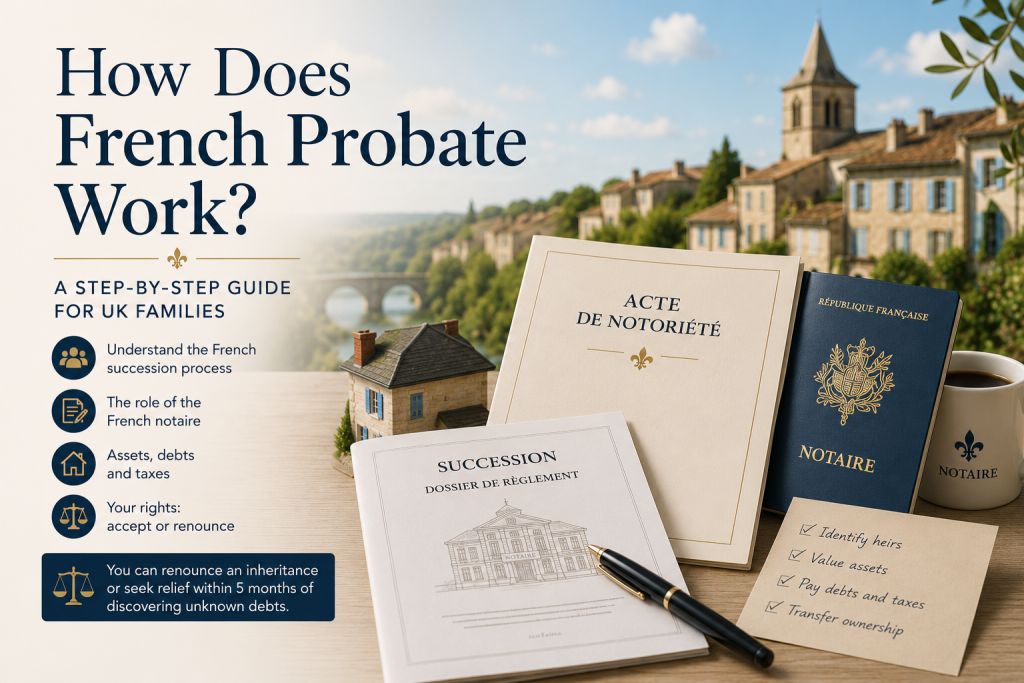
If you’ve recently lost a loved one who owned property or assets in France, you may be wondering what happens next.
French probate (more accurately known as a French succession) works quite differently from the probate process in England and Wales. There is no equivalent to the UK’s Grant of Probate in many successions, and instead the estate is administered by a French notary (notaire), who has a central legal role throughout the process.
Understanding the process can help reduce uncertainty and make it easier to work with your notary and any UK professionals involved.
Step 1 – Registering the Death
The succession begins when the death is registered and the French notary is instructed.
If the deceased owned property in France, a French notary will almost always be involved. The notary’s role is not to act for one particular heir, but to ensure the succession is administered correctly under French law.
The notary will begin gathering information about:
- The deceased.
- The surviving family members.
- Any wills.
- The deceased’s assets and debts.
- Whether any international succession rules apply.
Step 2 – Identifying the Heirs
One of the first tasks is establishing who the legal heirs are.
This often requires documents such as:
- Birth certificates.
- Marriage or civil partnership certificates.
- Divorce documentation where relevant.
- Death certificates for deceased spouses or children.
- Wills.
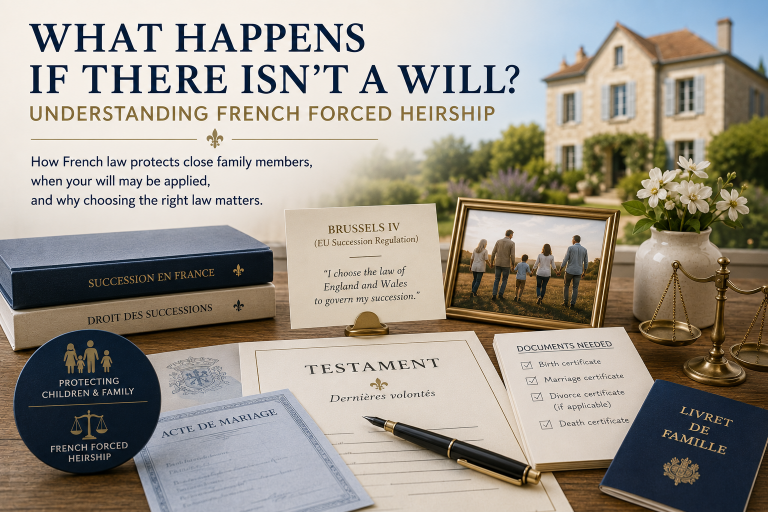
If the family is from the UK, the notary may ask about a French Livret de Famille (Family Record Book). Most UK families will not have one, so alternative documents are usually used to prove the family relationships.
Step 3 – Gathering Information About the Estate
The notary will then identify everything owned by the deceased together with any outstanding liabilities.
This may include:
- French property.
- UK property.
- French and UK bank accounts.
- Investments.
- Vehicles.
- Personal possessions.
- Business interests.
- Trust interests.
- Outstanding loans.
- Mortgages.
- Credit cards.
- Utility bills.
- Funeral expenses.
- Tax liabilities.
Where assets are located outside France, additional documentation may be needed from the relevant country.
Step 4 – Valuing the Estate
French inheritance tax is based on the value of the estate at the date of death.
The notary will usually require evidence of values, such as:
- Estate agent or surveyor valuations.
- Bank balances.
- Investment statements.
- Vehicle valuations.
- Professional valuations for valuable possessions.
Accurate valuations are important, as they form the basis of the inheritance tax declaration.
Step 5 – The Acte de Notoriété
One of the first formal documents prepared by the notary is the Acte de Notoriété (Act of Notoriety).
This legal document identifies the deceased, confirms who the legal heirs are and records the basis on which they inherit.
It is an important milestone in the succession and is often needed before banks and other organisations will release information or assets.
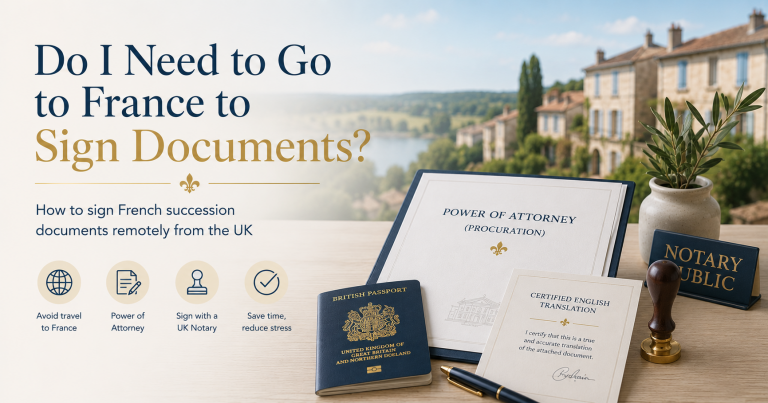
Many UK families are able to sign this remotely by granting the French notary a power of attorney (procuration) rather than travelling to France. If your notary offers this option, see our guide on Can I Sign French Succession Documents from the UK?
Step 6 – Paying Debts and Taxes
Before assets can usually be distributed, the estate’s debts and taxes must be addressed.
These may include:
- Funeral expenses.
- Outstanding household bills.
- Mortgages and loans.
- Credit card balances.
- Income tax.
- Property taxes.
- French inheritance tax.
The notary prepares the inheritance tax declaration and calculates any tax due by each beneficiary.
Step 7 – Transferring Ownership
Once the necessary documents have been completed and any taxes dealt with, ownership of the assets can be transferred.
For property, the notary updates the French Land Registry so that ownership reflects the new legal position.
Only after this stage can many inherited properties be sold or transferred to new owners.
Can You Refuse an Inheritance in France?
Yes.
French law allows an heir to renounce (renoncer à la succession) an inheritance.
This is most commonly considered where the deceased’s debts are greater than the value of their assets, meaning accepting the inheritance could leave the heir financially worse off.
A renunciation is a formal legal process and should not be confused with simply walking away from the estate.
If you are considering renouncing an inheritance, you should obtain legal advice before making your decision.
What If You Discover Unknown Debts Later?
French law also recognises that heirs cannot always know every debt when deciding whether to accept an inheritance.
If you have accepted the succession and later discover a significant debt that was genuinely unknown and which substantially affects the value of what you inherited, it may be possible to ask the court to relieve you from that acceptance.
In general, this application must be made within five months of discovering the debt, and the court will consider whether the legal conditions are met before granting relief.
This is a specialist area of French succession law, and professional advice should always be obtained if you find yourself in this situation.
How Long Does French Probate Take?
Every succession is different.
A straightforward estate may be completed within several months, while more complex estates involving UK assets, trusts, multiple heirs or tax issues can take considerably longer.
Factors that commonly affect timescales include:
- Missing documents.
- Property valuations.
- International assets.
- Multiple jurisdictions.
- Tax enquiries.
- Delays obtaining information from banks or government departments.
- The complexity of the family circumstances.
Final Thoughts
French probate can seem unfamiliar to UK families because it operates very differently from the probate process in England and Wales.
The key is to stay organised, provide documents promptly and maintain regular communication with your notary.
Understanding each stage of the process—from identifying the heirs and valuing the estate through to signing the Acte de Notoriété, paying inheritance tax and transferring ownership—can make what initially feels overwhelming much more manageable.
While every succession is unique, being prepared and understanding your options, including the possibility of renouncing an inheritance where appropriate, will help you make informed decisions throughout the process.