Guide
Repatriating a Loved One from France to the UK
A practical guide to repatriating a loved one from France to the UK, including choosing funeral directors, understanding the process, expected costs, legal requirements and practical advice based on real experience.

Choosing to bring a loved one home to the UK is one of the most personal decisions you’ll make following their death.
While the process is generally straightforward when managed by experienced funeral directors, it involves organisations in two countries, legal documentation, transportation arrangements and costs that many families do not expect.
Having been through this process myself, this guide explains what to expect and how to make the experience as smooth as possible.
Decide Early
One of the first decisions you’ll need to make is whether your loved one will:
- Be buried in France.
- Be cremated in France.
- Be repatriated to the UK.
This decision should ideally be made as early as possible because it determines the arrangements your French funeral director will begin making.
Find a French Funeral Director
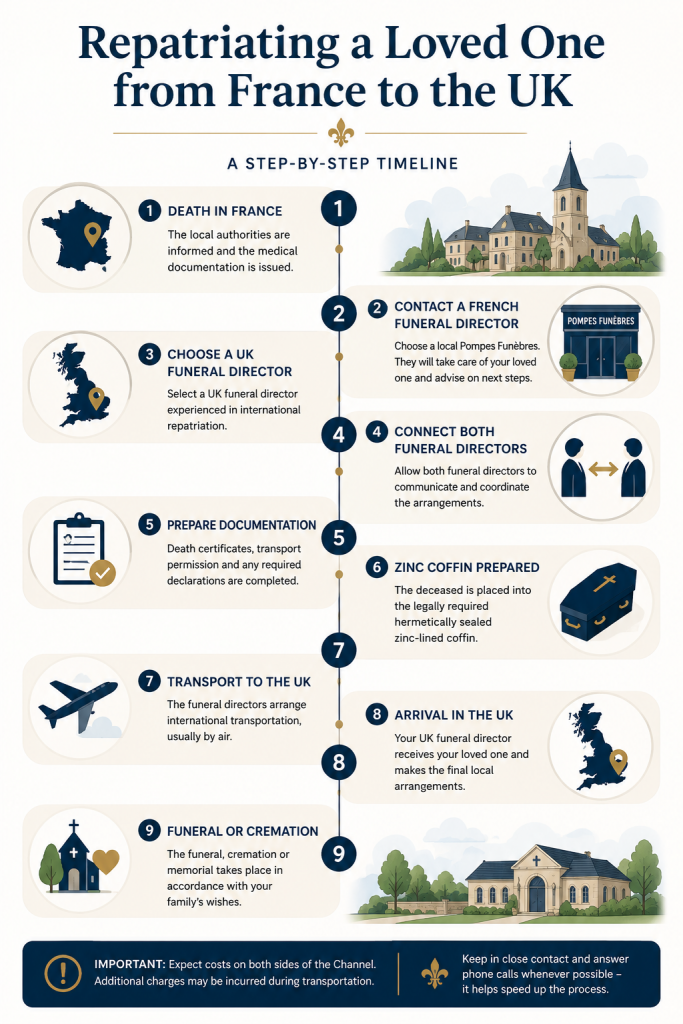
Your first step should always be finding a local French funeral director (Pompes Funèbres).
They will initially have responsibility for your loved one’s care and will begin arranging the legal documentation required for either a funeral in France or repatriation.
If you haven’t yet done so, read our guide:
→ Working with Funeral Directors in France
They can also explain local procedures, advise on timings and begin organising transportation.
Find a UK Funeral Director
You’ll also need a funeral director in the UK.
Both funeral directors will work together throughout the repatriation process.
Your UK funeral director will usually:
- Receive your loved one on arrival.
- Arrange transport within the UK.
- Organise the funeral or cremation.
- Help with paperwork required in the UK.
- Liaise with the French funeral director.
During our own experience, we chose The Co-op Funeralcare.
As a larger organisation, they had a dedicated repatriation team who worked alongside our local funeral director and coordinated the international arrangements.
Introduce Both Funeral Directors
Once you’ve chosen your UK funeral director, ask both organisations to contact one another directly.
Most of the detailed coordination happens between the two funeral directors, making the process much easier for the family.
Keeping everyone connected from the beginning helps avoid delays.
The Zinc Coffin Requirement
One aspect that often surprises UK families is the requirement for a zinc-lined coffin.
For international transportation of human remains, French regulations generally require the deceased to be placed in a hermetically sealed zinc coffin before transport.
This is a legal requirement for most international repatriations and forms part of the overall repatriation costs.
Your French funeral director will explain the requirements and arrange this on your behalf.
Understanding the Costs
International repatriation can be expensive.
You should expect costs on both the French and UK sides of the process.
These may include:
- French funeral director fees.
- Preparation of the deceased.
- Zinc coffin.
- International transportation.
- Airline or shipping charges.
- Administrative documentation.
- UK funeral director fees.
- Funeral or cremation costs in the UK.
In our own case, the French funeral director had already arranged the transportation, so we paid them directly for those costs. The total cost of Repatriation for me was around £6,000.
Other funeral directors may organise this differently, with some UK providers arranging transportation themselves.
Every case is different, so ask both funeral directors exactly what is included within their quotation.
Expect Additional Charges
One lesson we learned was that the initial quotation may not be the final cost.
Additional charges can arise during the transportation process, including fees associated with airlines, transportation providers or changes to arrangements.
Although not every family experiences these additional costs, it’s sensible to keep some contingency within your budget.
Coroner Timeline
Do be aware that once the body of your loved one has arrived in the UK, it will need to be inspected by the coroner and is mandatory for all repatriations, this can add unexpected delays and cause concern but it is perfectly normal.
During this process the coroner will issue a UK death certificate and perform the necessary steps to register the death in the UK for you.
Do not be surprised if this office calls you directly to communicate with you, this is common and very helpful at understanding a timeline however if the cause of death is difficult to identify this may be over a protracted timeline.
Keep Your Phone Nearby
Throughout the repatriation process, communication is extremely important.
Both funeral directors, transportation providers and administrative staff often prefer resolving questions by telephone.
Try to answer calls whenever possible or return missed calls promptly.
Quick conversations can often resolve issues in minutes that might otherwise take days by email.
Visiting France
Depending on your circumstances, you may still need to travel to France.
Your French funeral director will advise whether you need to sign any declarations or documentation in person.
Even if this isn’t strictly necessary, visiting France can still be worthwhile.
It gives you the opportunity to:
- Spend time with your loved one.
- Meet your French funeral director.
- Meet your notaire.
- Inspect the property.
- Meet estate agents.
- Arrange handymen or cleaners.
- Begin gathering important documents.
Making use of one visit can save significant time and expense later.
Saying Goodbye
One aspect of French funeral care that many UK families find comforting is the opportunity to visit their loved one before the funeral.
Many funeral homes have dedicated viewing rooms where family members can spend time with the deceased before burial, cremation or repatriation.
Your funeral director will explain the arrangements available.
If travelling to France is possible, many families find this an important opportunity to say goodbye.
Talk to Your Employer
If you’re employed, check your company’s bereavement policy as early as possible.
Many organisations offer compassionate leave following the death of a close family member.
However, if you are responsible for arranging the funeral, repatriation or administering the estate, your employer may offer additional leave beyond their standard bereavement entitlement.
In my own case, although the standard policy allowed only a few days for bereavement, additional leave was available because I was organising the funeral and managing the practical arrangements.
Every employer’s policy is different, so it’s worth speaking to your manager or Human Resources department as soon as possible.
Final Thoughts
Although repatriation can initially seem overwhelming, experienced funeral directors carry out this work regularly and will guide you through each stage.
The key is choosing reliable funeral directors in both France and the UK, keeping communication open and understanding that the process involves legal formalities, international transport and costs that may change as arrangements progress.
Planning ahead, asking questions and staying available throughout the process will help ensure your loved one is brought home with dignity and care.