Guide
French Succession Explained
Understand the complete French succession process from start to finish. Learn how the Act of Notoriety, Declaration of Succession, inheritance tax, property transfers and UK–France cross-border probate fit together, with realistic timelines and practical guidance for British families inheriting assets in France.
Losing a loved one is difficult enough without trying to understand another country’s legal system. If your relative owned property or assets in France, you’ll quickly discover that French succession follows a very structured legal process which can feel overwhelming, particularly for families living in the UK.
This guide explains the complete French succession process from beginning to end, what each legal document does, how long each stage usually takes, and why UK–France cross-border estates almost always take considerably longer than purely French successions.
What is French Succession?
French succession is the legal process of identifying who inherits a deceased person’s estate, calculating any inheritance tax that may be due, transferring ownership of assets, and ultimately closing the estate.
Unlike the UK, where probate is generally administered through the courts, France places much of this responsibility on a notaire (notary).
The notary acts as a neutral public official appointed by the French government. They do not represent one family member over another; instead, they ensure the estate is distributed according to the applicable law.
If the deceased owned French property, using a French notary is usually unavoidable.
The Typical French Succession Timeline
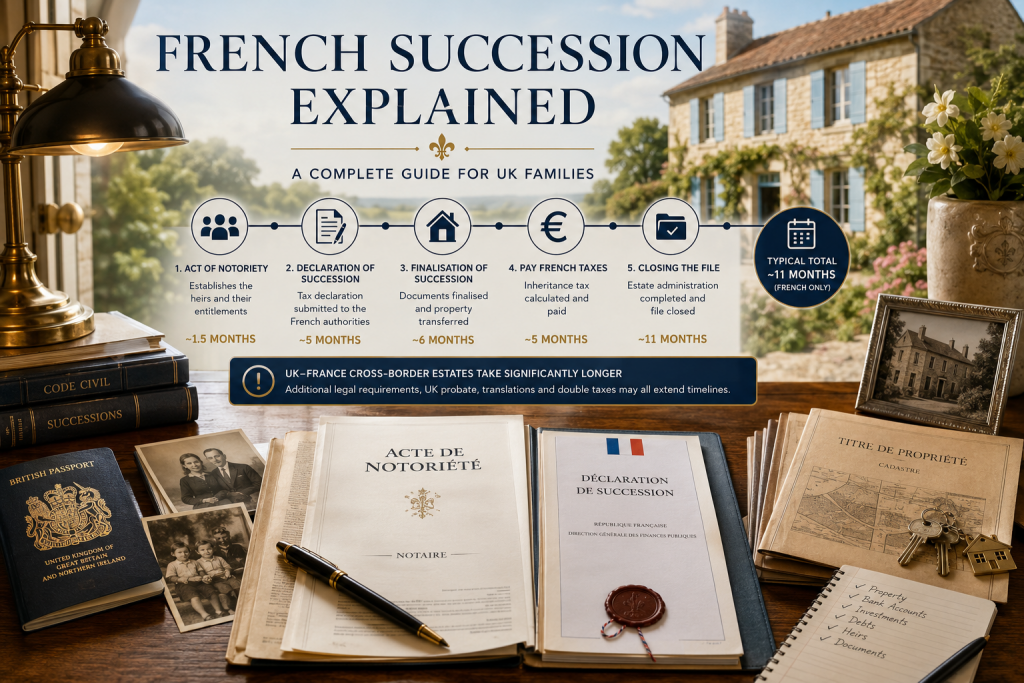
Every estate is different, but a straightforward French succession often follows roughly this timetable:
| Approximate Time | Stage |
|---|---|
| Within a few weeks | Initial documents gathered |
| Around 1–2 months | Act of Notoriety completed |
| Around 5 months | Declaration of Succession prepared |
| Around 6 months | Succession documents finalised and property transferred |
| Around 11 months | Estate administration completed and file closed |
These are only typical timelines for straightforward French estates.
If the deceased lived abroad, had assets in multiple countries, owned trusts, had English wills, or UK probate is also required, the process may take considerably longer.
Stage 1 – Gathering Information
The first task is simply establishing what exists.
The notary will begin collecting information such as:
- Identity documents
- Death certificate
- Birth certificates
- Marriage or civil partnership certificates
- Divorce documents where applicable
- Details of children and other heirs
- Property ownership
- Bank accounts
- Existing wills
- Previous gifts
- Insurance policies
- Mortgage information
If you are a UK family, obtaining and translating documents is often one of the biggest delays.
Many notaries will also ask for a Family Record Book (Livret de Famille). UK families rarely have one, so instead you’ll normally need to provide civil status documents proving the family relationships.
See Gathering
Stage 2 – The Act of Notoriety
The first major legal document is the Act of Notoriety (Acte de Notoriété).
This document does not distribute the estate.
Instead, it legally establishes:
- who has died
- who the legal heirs are
- what relationship each heir has to the deceased
- whether a will exists
- which inheritance law applies
Think of it as the legal document that officially says:
“These are the people entitled to inherit.”
Until this document is completed, very little else can progress.
Banks, insurance companies and other organisations often require it before releasing information or funds.
For a straightforward French succession, this is commonly completed around six weeks after the notary has received all necessary documentation.
Cross-border estates frequently take much longer because additional legal questions often need answering first.
Stage 3 – Valuing the Estate
Once the heirs have been established, the estate itself needs to be valued.
This includes things such as:
- French property
- Bank accounts
- Investments
- Vehicles
- Valuable possessions
- Outstanding debts
Professional property valuations may be required.
The estate value forms the basis for inheritance tax calculations.
Stage 4 – The Declaration of Succession
The Declaration of Succession (Déclaration de Succession) is one of the most important documents in the entire process.
This is essentially the tax return for the estate.
It records:
- every asset
- every debt
- every beneficiary
- inheritance calculations
- inheritance tax due
Many people mistakenly believe this document transfers ownership.
It doesn’t.
Its primary purpose is taxation.
French inheritance tax generally becomes payable at this stage if applicable.
For estates where the deceased died while resident outside France, or where cross-border tax matters exist, additional information may be required.
Stage 5 – Property Transfers
Once the legal and tax requirements have been completed, ownership of French property can be updated.
Depending on the circumstances, the notary prepares the documents needed to register the new ownership with the French Land Registry.
Only after these registrations have been completed can beneficiaries usually sell inherited property, unless they already held rights such as usufruct, which may allow earlier disposal depending on the circumstances.
The updated ownership documents (deeds) will often be required by estate agents if you later decide to sell.
Stage 6 – Completing the Succession
Once:
- taxes have been settled
- property transfers have been registered
- assets have been distributed
- outstanding issues resolved
the notary can close the succession file.
For a straightforward French estate this is often around eleven months after death, although larger or more complex estates can remain open for much longer.
How Long Does a UK–France Succession Take?
This is probably the question we are asked most often.
Unfortunately, there is no simple answer.
The timelines above are generally applicable to estates that are entirely French.
Cross-border estates introduce many additional complications that can significantly extend the process.
Examples include:
- UK probate
- English wills
- Different succession laws
- Trusts
- Asset ownership in multiple countries
- Certified translations
- Apostilles
- Obtaining UK certificates
- Communication between UK solicitors and French notaries
In practice, it is not unusual for UK–France successions to take considerably longer than a domestic French succession.
Patience is often required.
Why Do Cross-Border Estates Take Longer?
French notaries are experts in French law.
When UK legal concepts become involved—particularly trusts, probate procedures, or wills governed by the law of England and Wales—additional legal opinions may be required before they can proceed.
Documents may need to be:
- translated
- certified
- apostilled
- explained by UK solicitors
- accepted by French authorities
Each additional step inevitably increases the timeline.
Do You Need UK Probate As Well?
Sometimes.
Whether UK probate is required depends on what UK assets existed and which organisations require it.
Many families therefore find themselves dealing with two separate legal processes simultaneously:
- French succession
- UK probate
Although related, they are independent legal procedures and often progress at different speeds.
In my case, the UK Probate was required after the act of notary to establish the assets in the UK, so it is imperative to begin the UK Probate process as soon as possible alongside the French succession.
Common Misunderstandings
“The Act of Notoriety means the estate is finished.”
No.
It only identifies the heirs.
Several major stages still remain.
“The Declaration of Succession transfers ownership.”
Not quite.
Its main purpose is declaring the estate to the French tax authorities.
Separate legal documents deal with ownership registration.
“Everything should finish within six months.”
Only in relatively straightforward cases.
International estates frequently take much longer.
Our Advice
The most important thing you can do is provide documentation as quickly as possible.
Many delays occur because certificates, translations or legal documents are missing.
Keeping scanned copies of everything, responding promptly to your notary, and understanding which stage the succession is currently at can make the process much less stressful.
Most importantly, remember that long periods of silence do not necessarily mean nothing is happening. Cross-border estates often involve correspondence between multiple authorities, banks, solicitors and tax offices, much of which happens behind the scenes.
Related Guides
If you’re dealing with a French succession, these guides may also help:
- Finding a notary
- What is a Family Record Book?
- How to obtain a UK Birth Certificate
- How to translate UK documents for France
- Selling inherited property in France
- How to obtain your French property deeds
- French inheritance tax explained
- How French probate works
Final Thoughts
French succession is a structured legal process with clearly defined stages. Understanding what each document does—and just as importantly, what it does not do—can make the process far easier to follow.
For UK families, expect additional legal and administrative work compared with a purely French estate. While this often means a longer timeline, good preparation and understanding of the process can help reduce delays and avoid unnecessary frustration.