Guide
Gathering Documents for a French Succession
Preparing documents for a French succession can feel overwhelming, especially for UK families dealing with cross-border inheritance. This guide explains which documents your French notary needs for the Act of Notoriety and Declaration of Succession, what alternatives may be accepted when documents are missing, and how to prioritise the paperwork to avoid unnecessary delays.
One of the first things your French notary will ask you to do is gather a considerable amount of documentation. For many UK families, this quickly becomes one of the most time-consuming parts of the entire succession.
The good news is that you do not normally need every document immediately.
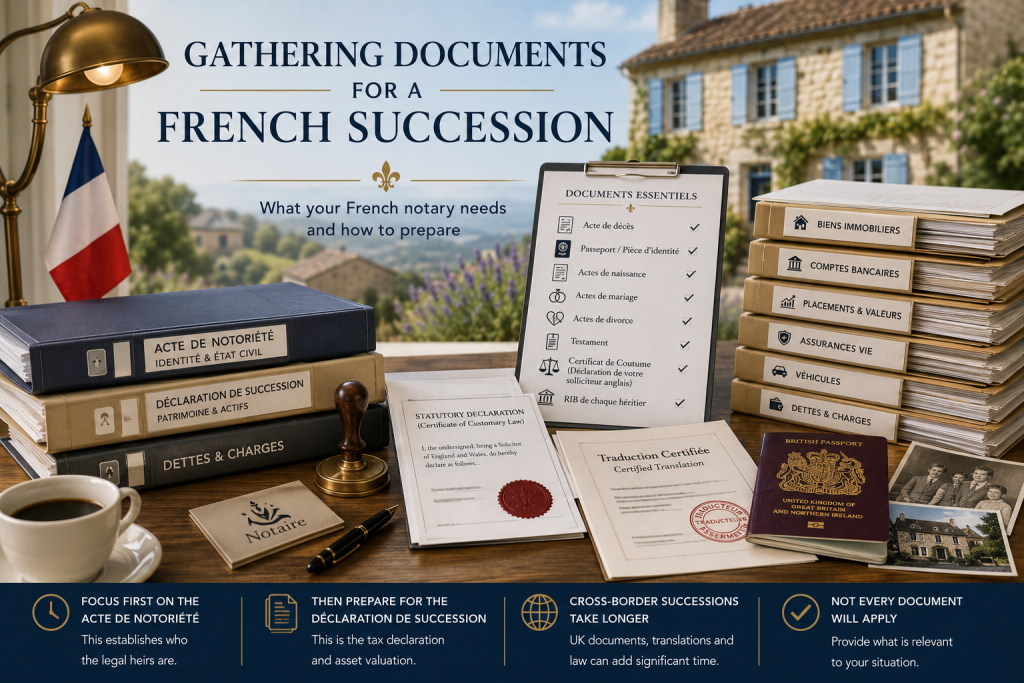
Although your notary may provide a very long checklist at the outset, the succession is completed in stages. Focusing first on the documents needed for the Act of Notoriety will often allow the succession to begin while you continue gathering the remaining paperwork for the later stages.
This guide explains which documents are usually required, why they are needed, and what alternatives may be accepted where documents simply no longer exist.
Why Does the French Notary Need So Many Documents?
Unlike the UK probate system, a French notary is responsible for both establishing who inherits the estate and preparing the tax declaration.
Before they can do either, they must answer three fundamental questions:
- Who has died?
- Who are the legal heirs?
- What assets and liabilities make up the estate?
Every document they request helps answer one of those questions.
Stage One – Documents for the Act of Notoriety
The Act of Notoriety (Acte de Notoriété) is the first major legal document prepared during a French succession.
Its purpose is to legally establish who the heirs are.
Although every estate is different, you will commonly be asked for the following.
Death Certificates
Your notary will usually request:
- Two original copies of the death certificate.
If the death occurred in France, these are generally obtained from the relevant French town hall.
Identity Documents
Each heir will normally need to provide:
- Passport or national identity card
- Current address
- Telephone number
- Email address
- Profession
- Current marital status
Civil Status Documents
These are used to prove family relationships.
Depending on your circumstances, this may include:
- Birth certificates for all heirs
- Marriage certificates
- Civil partnership certificates
- Divorce certificates
- Death certificates of previous spouses where applicable
If there have been multiple marriages or divorces, expect to provide documentation for each.
Don’t Worry About the Family Record Book
Many French notaries ask for the Livret de Famille (Family Record Book).
For French families, this is entirely normal.
For UK families, however, it is usually a problem because no equivalent document exists.
In our own succession, we instead supplied a combination of:
- Birth certificates
- Marriage certificates
- Divorce certificates
- Death certificates relating to previous spouses
Together, these established exactly the same family relationships that a French Family Record Book would normally prove.
Alongside this I was required to provide a statutory declaration written by my UK solicitor reaffirming that we are the heirs – this document also acts as the certificate of coutume (see below) and required certified translation. The document as an example for you and possibly your UK solicitor can be found here: https://www.frenchprobate.uk/certificate_du_coutume.zip
If your notary requests a Family Record Book and you are a UK family, don’t panic. It usually means you’ll simply need to provide the underlying civil status documents instead.
The Will
If the deceased left a will, provide a copy as early as possible.
The original may ultimately be required depending on where it is held.
If you are unsure where the will is, like I was, contact the local notary offices to check, most likely the notary’s who also handled any property purchases/sales for your loved one. Use an advocat to perform searches of the French Will authorities. Also use a UK solicitor to check the UK Will Registrar.
This for me was one of the most frustrating stages as we could not locate one nor did the notary originally register it. Our advocat was able to finally track down the will by contacting all local notaries to the area, you can do this yourself if you want to speed up the process.
Gifts Between Spouses
If there were any:
- donations between spouses
- marriage contracts
- previous inheritance arrangements
these should also be provided.
Disability Documentation
Where applicable, copies of disability certificates or disability cards for beneficiaries should also be supplied, as these may affect inheritance tax allowances.
Bank Details for Each Heir (RIB)
Your notary may request a RIB (Relevé d’Identité Bancaire) for each beneficiary.
A RIB is simply the French banking document containing the account holder’s:
- IBAN
- BIC
- bank details
Your notary may ask that each copy is dated and signed before submission.
If you do not have a French bank account, discuss suitable alternatives with your notary.
The Certificate of Customary Law (Certificat de Coutume)
This is one of the areas that causes the greatest confusion for UK families.
French notaries frequently request a Certificate of Customary Law (Certificat de Coutume) to confirm how English law applies to the estate.
The difficulty is that the UK does not have an official government-issued Certificate of Customary Law.
Instead, what is commonly provided is a declaration prepared by a UK solicitor explaining the relevant English law.
In our case, our solicitor prepared a statutory declaration confirming:
- the applicable law of England and Wales;
- the identity of the deceased;
- the known legal heirs;
- that, to the best of their knowledge, those named were the only beneficiaries entitled to inherit.
Our French notary accepted this in place of a formal Certificate of Customary Law.
Because this document is produced in English, it also required a certified French translation before it could be used in the succession. See https://www.frenchprobate.uk/certificate_du_coutume.zip as an example document.
Documents Commonly Required for the Act of Notoriety
For most UK families, this stage typically involves collecting:
- Death certificates
- Passports or identity documents
- Birth certificates
- Marriage certificates
- Divorce certificates
- Death certificates of previous spouses (where applicable)
- Current addresses
- Telephone numbers
- Email addresses
- Profession of each heir
- Marital status
- The deceased’s will
- Marriage contracts or gifts between spouses
- Disability certificates where relevant
- RIB (bank details) for each heir
- Certificate of Customary Law or solicitor’s statutory declaration
- Certified translations where required
Completing this stage often takes the longest because many of these documents must first be ordered from the UK before they can be translated.
Stage Two – Documents for the Declaration of Succession
Once the heirs have been established, the focus shifts from identifying beneficiaries to valuing the estate.
The Declaration of Succession is effectively the estate’s tax return.
The documentation requested now becomes much broader.
Previous Gifts and Inheritances
Your notary may request copies of any:
- inheritance declarations
- certificates of ownership
- gifts
- manual gifts
- shared gifts
- donation documents
- previous estate accounts
They may also ask for documents relating to property owned before marriage, even if that property has since been sold.
Gifts Made by the Deceased
If the deceased made gifts during their lifetime, you should provide documentation relating to them where available.
This may include:
- manual gift declarations
- monetary gifts
- shared donations
- transfer records
- cheque copies
UK Probate Documents
If the deceased also left assets in the United Kingdom, your French notary will usually require copies of the UK probate documentation once available.
This enables them to correctly declare overseas assets.
As soon as you have submitted the UK Probate forms, I recommend sending them automatically to the French notary as this caused a significant delay for us since our notary simply didn’t ask us for it till many months later.
Trust Documentation
Where trusts are involved, your notary will usually need:
- copies of all trust deeds; (Can be the will defining the trust – sometimes a deed is not produced and a Will acts as the deed – you may need to explain this to your notary, check with the UK Probate solicitor who handled any wills which formed a trust first).
- any amendments;
- legal confirmation explaining the deceased’s rights to capital and income. – This can be in the form of a solicitors letter.
Cross-border trusts are one of the main reasons UK–France successions take considerably longer than domestic French estates.
Financial Assets
Typically requested documents include:
- Bank statements
- Savings accounts
- Investment accounts
- Securities
- Foreign bank accounts
- Life insurance policies
- Pension statements
- Salary slips
- Employee share schemes
- Shareholdings in companies
- Company accounts where applicable
Property
Where property is owned, your notary will generally request:
- Title deeds – Your notary should be able to acquire these for France, for UK you will need to prove ownership from the Land Registry and work with a UK solicitor to gather this documentation.
- Property valuations – Your notary may be able to handle the first valuation but require an independent valuation as well, see: https://frenchprobate.uk/guides/working-with-estate-agents/
- Rental agreements
- Managing agent details
- Business valuations where applicable
Vehicles and Other Assets
This commonly includes:
- Cars, see: https://frenchprobate.uk/guides/acquiring-a-car-registration-certificate/
- Boats
- Caravans
- Motorcycles
- Valuable collections
If registration documents have been lost, don’t panic.
During our own succession we were unable to locate a vehicle registration document. Instead, we supplied the vehicle details together with a valuation, and our notary was happy to continue.
Always discuss missing documents with your notary before assuming the succession cannot proceed.
Debts and Liabilities
Your notary also needs to know what the estate owes.
This often includes:
- Income tax
- Property tax
- Council tax
- Wealth tax (where applicable)
- Mortgages
- Personal loans
- Credit agreements
- Funeral invoice, including repatriation costs.
- Care home fees
- Service charges
- Outstanding works
- Foreign liabilities
You Probably Won’t Need Everything
When you first receive a French notary’s checklist it can feel overwhelming.
Remember that it is designed to cover almost every possible estate.
Many items simply won’t apply.
You may not own:
- a business;
- boats;
- employee share schemes;
- foreign investments;
- company current accounts;
- rental properties;
- agricultural land.
Equally, some documents may simply no longer exist.
Your notary will usually work with reasonable alternatives where appropriate.
The important thing is to explain what is unavailable rather than ignoring the request.
Our Advice
If you’re dealing with a UK–France succession, don’t try to gather everything at once.
Instead:
- Concentrate first on the documents needed for the Act of Notoriety.
- Allow the succession to begin.
- Continue gathering the financial documentation needed for the Declaration of Succession while the notary prepares the first legal documents.
This approach makes the workload far more manageable and often avoids delaying the early stages of the succession.
Related Guides
If you’re collecting documents for a French succession, these guides may also help: