Guide
Selling a Car After a Death in France
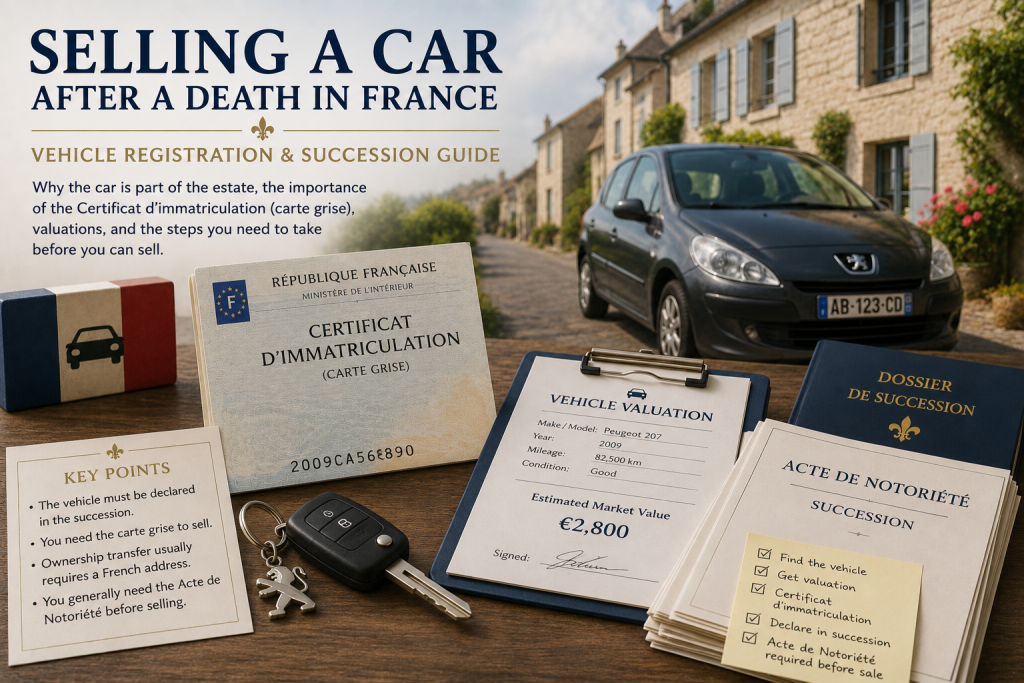
A vehicle forms part of your loved one's estate and must usually be declared during the French succession. This guide explains why you need the vehicle registration certificate, how to obtain a valuation, and the practical challenges of selling a French-registered vehicle from the UK.
When someone dies in France, it’s easy to focus on property and bank accounts.
However, don’t forget about the car.
A vehicle is an asset of the estate and usually needs to be declared as part of the French succession.
Even if it isn’t worth a great deal, it still has a value that your notaire will usually need to include when preparing the succession documents.
Find the Vehicle
Before anything else, make sure you know where the vehicle is.
Don’t assume it will be parked outside the property.
In our own case, we only discovered the car’s location after speaking with a neighbour, who told us it had been left at a local mechanic for repairs.
Without that conversation, we might have spent days searching for it.
Useful people to ask include:
- Neighbours.
- The funeral director.
- Family members.
- Local mechanics.
- Friends of the deceased.
Obtain a Valuation
Your notaire will normally require an approximate value for the vehicle so it can be included within the estate.
One of the easiest ways to obtain this is to ask a local:
- Garage.
- Vehicle dealer.
- Mechanic.
- Car valuation specialist.
In our case, a local garage was happy to provide a valuation for the succession.
Keep a copy of any written valuation for your records.
The Vehicle Registration Certificate
One of the most important documents is the French vehicle registration certificate.
This is officially called the:
Older documents and many French people still refer to it as the:
Carte Grise
Without this document, selling the vehicle later becomes significantly more difficult.
What If You Can’t Find It?
This is unfortunately more common than you might think.
Although many people keep the registration certificate with the vehicle, others store it safely at home.
In our own succession, it wasn’t in either location.
We still haven’t located it.
A replacement certificate (duplicata) can normally be requested, but after a death this can become considerably more complicated because the registered owner is no longer able to make the application personally.
In practice, you may need assistance from your avocat, notaire or another authorised representative.
The Address Problem
One practical difficulty for many UK beneficiaries is that French vehicle administration generally expects a French address for registration purposes.
If a replacement registration certificate needs to be issued, you’ll often need someone in France to receive correspondence.
Possible options include:
- A trusted neighbour.
- A close family member living in France.
- Your avocat (if willing).
- Another trusted local contact.
Many professionals are understandably reluctant to receive official documents on behalf of clients, so discuss this with them before assuming they can help.
You Usually Can’t Sell the Vehicle Immediately
Even if you have located the vehicle and found the registration certificate, you’ll generally still need to wait until the succession has progressed.
The notaire must first establish who has inherited the vehicle.
Only once the necessary succession documentation has been completed—such as the Acte de Notoriété and any other required paperwork—can ownership be dealt with and the vehicle sold.
For this reason, don’t expect to sell the vehicle immediately after the death.
Consider Depreciation
Unfortunately, delays can reduce the value of the vehicle.
While waiting for the succession to progress:
- Keep the vehicle secure.
- Protect it from weather where possible.
- Check the battery periodically.
- Inflate the tyres if it will remain stationary.
- Consider whether insurance needs to remain in place.
- Ask a trusted local person to inspect it occasionally.
Taking simple steps can help preserve its value until it can eventually be sold.
Documents You’ll Eventually Need
Depending on the circumstances, you may require:
- Vehicle registration certificate (Certificat d’immatriculation).
- Death certificate.
- Succession documents.
- Identification.
- Vehicle valuation.
- Maintenance records.
- MOT (Contrôle Technique) if required for the sale.
Your notaire can advise which succession documents will ultimately be required before ownership can be transferred or the vehicle sold.
Final Thoughts
Vehicles are often forgotten during the early stages of a succession, yet they remain valuable assets that must usually be declared.
Finding the car, locating its registration certificate and obtaining a valuation early will make the eventual sale much easier.
If the registration certificate is missing, don’t leave the problem until the succession has finished. Begin discussing possible solutions with your notaire or avocat as soon as possible, as obtaining a replacement can take time and may require someone in France to assist with the administrative process.