Guide
Working with Funeral Directors in France
Learn how to find a funeral director in France, why contacting them quickly is essential, what decisions you'll need to make immediately after a death, and how they can become one of your most valuable local contacts during a French succession.
One of the very first people you’ll need to contact after a loved one dies in France is a local funeral director.
This is often the most urgent practical task following a death, as arrangements for the deceased need to begin quickly.
In addition to organising the funeral or cremation, a funeral director can become an invaluable source of local knowledge and support throughout the early stages of the succession.
Find the Local Funeral Director
Funeral directors in France are known as Pompes Funèbres.
Your first step should be identifying the funeral director serving the area where your loved one lived or passed away.
If you’re unfamiliar with the area, search online for:
- Pompes Funèbres + the town name
- Funeral Director + the town name
If the deceased lived in a small village, you may need to search for the nearest larger town, as this is often where the local funeral director will be based.
Contact Them Immediately
Time is important.
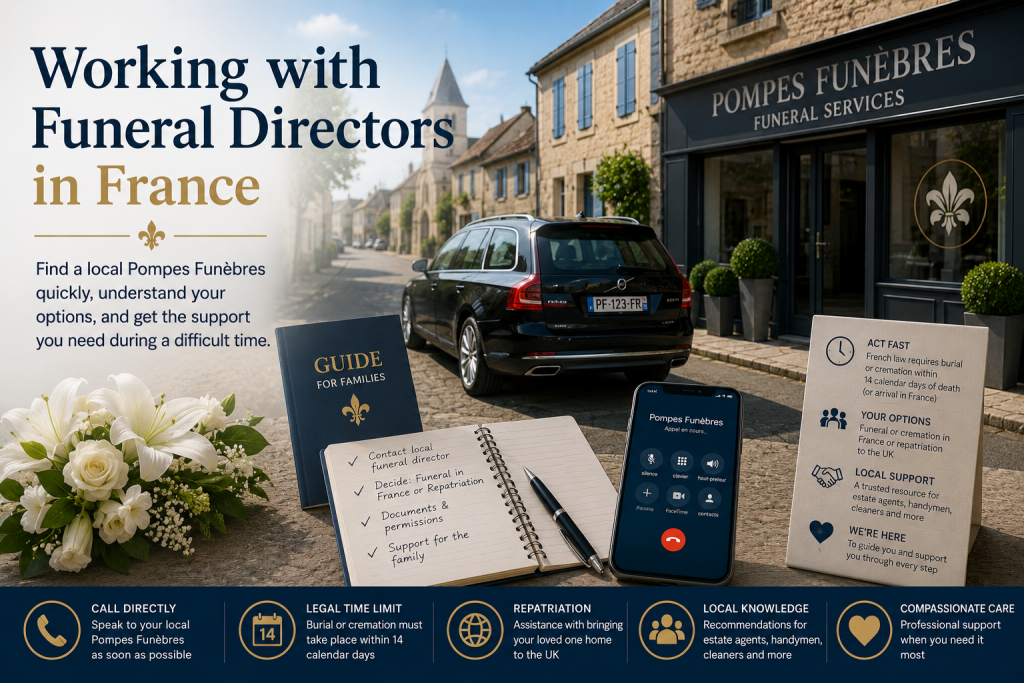
Rather than relying on email, it’s usually best to telephone the funeral director as soon as possible.
Time is particularly important following a death in France. Because French law sets strict time limits for burial or cremation, you should telephone the local funeral director as soon as possible. A direct conversation allows arrangements to begin immediately and helps avoid unnecessary delays while you travel from the UK or make decisions about the funeral or repatriation.
Speaking directly allows arrangements to begin immediately and gives you the opportunity to explain your circumstances, particularly if you’re travelling from the UK.
Even if your French is limited, don’t let this put you off. Many funeral directors have experience helping international families and, if necessary, simple English, translation tools or a follow-up email can bridge any language barriers.
Funeral Arrangements in France
France generally expects funerals or cremations to take place relatively quickly after a death.
In many cases, this is within a few days, unless there are legal, medical or administrative reasons that require a delay.
By French law, a body must be buried or cremated within 14 calendar days of death (or within 14 days of the body arriving in mainland France if the death occurred overseas). Failing to meet this timeframe without an official exemption is an offense.
Because of this, it’s important to make contact with a funeral director as soon as possible so that arrangements can begin without unnecessary delay.
Decide What You Want to Do
One of the first decisions you’ll need to make is what you would like to happen to your loved one’s remains.
Broadly, there are two options.
Funeral or Cremation in France
The local funeral director can organise the funeral or cremation within France and work with you throughout the process.
They’ll liaise with the relevant authorities, cemetery or crematorium, and can usually advise on local customs and procedures.
Repatriation to the UK
If your loved one wished to return to the UK, or your family decides this is the preferred option, the French funeral director can assist with the repatriation process.
They’ll work alongside a UK funeral director to arrange the necessary documentation, transport and handover.
For a detailed explanation of the process, see our guide:
→ Repatriating a Loved One from France to the UK
Finding a UK Funeral Director
If you’re arranging repatriation, you’ll also need a funeral director in the UK.
In my own family’s case, we used The Co-op Funeralcare, whose specialist repatriation team guided us through the process and coordinated directly with the French funeral director.
Having experienced professionals managing both sides of the journey made a difficult situation considerably easier.
We’ll cover the repatriation process in detail in a dedicated guide.
A Valuable Source of Local Knowledge
Once the immediate funeral arrangements are underway, don’t overlook one of the funeral director’s greatest strengths—their local knowledge.
Funeral directors work closely with many local professionals and are often able to recommend trusted businesses.
For example, they may know:
- Estate agents
- Handymen
- Cleaners
- Plumbers
- Locksmiths
- Gardeners
- Pest control specialists
- Property managers
In my own experience, this local knowledge proved invaluable.
The handyman and cleaner who helped us secure and prepare the property were both recommended by the funeral director.
Local recommendations are often far more useful than simply searching online, particularly if you’re unfamiliar with the area.
Don’t Be Afraid of the Language Barrier
Many UK families worry about speaking to French professionals.
In practice, there are many ways to communicate successfully.
During our own succession, we used a combination of:
- Simple English where understood.
- Basic French.
- Google Translate during face-to-face conversations.
- Emails translated into French using ChatGPT.
- Google Translate to understand replies.
Although conversations weren’t always perfect, we were able to organise everything we needed.
Don’t let concerns about language stop you making that first phone call.
Questions to Ask
When you first speak with the funeral director, consider asking:
- Can you assist with a funeral in France?
- Can you assist with repatriation to the UK?
- What information do you need from me?
- What are the likely timescales?
- Can you recommend a local estate agent?
- Do you know a reliable handyman or cleaner?
- Are there any immediate actions I should take regarding the property?
These conversations often provide valuable guidance beyond the funeral itself.
Final Thoughts
Finding a funeral director is one of the first and most important practical steps after a death in France.
Not only will they help care for your loved one and guide you through the immediate arrangements, but they can also become one of your most valuable local contacts throughout the succession.
Whether you’re arranging a funeral in France or organising repatriation to the UK, establishing that relationship early can make the weeks that follow significantly less stressful.