Guide
What Is a French Family Record Book (Livret de Famille)?
If you're dealing with a French succession, you may be asked for a Livret de Famille (Family Record Book). Most UK families have never heard of one, which can lead to confusion and delays. This guide explains what it is, why French notaires ask for it, and how UK families can usually provide alternative evidence.
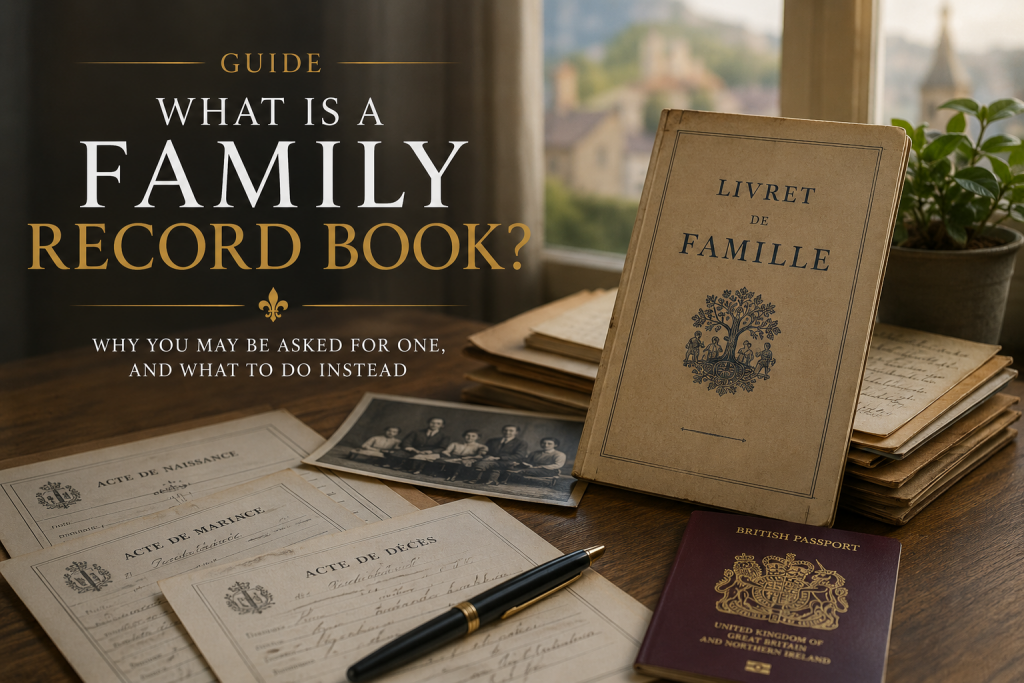
One of the first documents your French notaire may ask for is something called a Livret de Famille, or Family Record Book.
For many British families, this request comes as a complete surprise.
The UK has no equivalent document, and many people understandably spend hours searching for something that simply doesn’t exist.
The good news is that, as a UK family, you will usually be able to provide alternative documents instead.
What Is a Livret de Famille?
A Livret de Famille is an official French family record book.
It was introduced to record the key civil status events within a family.
As life events occur, the book is updated to include matters such as:
- Marriage or civil partnership.
- Birth of children.
- Adoption.
- Divorce.
- Death of a spouse.
- Death of children.
Rather than having to collect numerous individual certificates, French families often present their Livret de Famille as a convenient summary of the family’s civil status.
Why Does the Notaire Want It?
The purpose is simple.
The notaire needs to establish who the legal heirs are.
The Livret de Famille makes that task straightforward because it records the family’s relationships in one place.
However, the document itself is not essential.
If no Livret de Famille exists—as is often the case for British families—the notaire will simply ask for other evidence proving the same information.
What Should UK Families Provide Instead?
In our own succession, we were asked to provide individual civil status documents instead.
These included:
For the deceased
- Birth certificate.
- Marriage certificate (or civil partnership certificate).
- Divorce certificate or final order (if applicable).
- Death certificate of any former spouse (where relevant).
For each child
- Birth certificate.
- Identification.
- Death certificate (if a child has predeceased the parent).
These documents allow the notaire to reconstruct the same family relationships that would normally appear in a French Livret de Famille.
A Statutory Declaration May Also Help
In our case, our UK probate solicitor prepared a statutory declaration confirming that, to the best of our knowledge, the named individuals were the only children of the deceased.
The declaration was then independently witnessed by another solicitor.
This provided additional evidence to support the succession.
If your solicitor does not offer witnessing services themselves or requires that statutory declarations written by themselves is signed by third-party law firms, many local law firms will witness statutory declarations for a modest fee—often somewhere between £5 and £20.
You may need to telephone several firms, as not every practice offers this service.
If one firm cannot help, they can often recommend another local solicitor who can.
Although every notaire has their own requirements, a statutory declaration like this may provide useful supporting evidence alongside the official certificates.
What If There Were Previous Marriages?
Don’t forget previous relationships.
If the deceased was married more than once, your notaire will usually need evidence showing how each marriage ended.
This may include:
- Divorce certificates.
- Final orders.
- Death certificates of former spouses.
These documents help establish who may—or may not—have inheritance rights.
Providing them early can prevent unnecessary delays.
Children Have Equal Rights
One concern some families have is whether children born outside marriage have different inheritance rights.
Under modern French succession law, they do not.
Children generally have the same inheritance rights regardless of:
- Whether their parents were married.
- Their gender.
- Their date of birth.
- Whether they are the eldest or youngest child.
In other words, there is no concept of the “first-born son” inheriting ahead of other children.
The notaire’s objective is simply to identify all of the legal heirs.
Why This Causes Confusion
Many UK families assume they have misunderstood the request.
After all, they’ve never seen or heard of a Family Record Book before.
In reality, the confusion arises because France has a document that simply doesn’t exist in the UK.
Once your notaire understands that the deceased was British, they will usually accept other official documents that establish the same family relationships.
Practical Checklist
If you’re asked for a Livret de Famille and don’t have one, start collecting:
- ✓ Birth certificate of the deceased.
- ✓ Marriage or civil partnership certificate.
- ✓ Divorce documentation (where applicable).
- ✓ Death certificates of former spouses (where applicable).
- ✓ Birth certificates of all children.
- ✓ Death certificates for any children who have died.
- ✓ Identification documents.
- ✓ Any statutory declaration requested by your solicitor or notaire.
Having these documents ready early in the succession can save weeks of correspondence later.
The below guide can be useful to you here:
You can also request a solicitor to help you gather these but ultimately you’ll be overpaying for what you can do. Other certificates can be found easily in similar steps to the above at the same web portal:
https://www.gov.uk/order-copy-birth-death-marriage-certificate
Final Thoughts
Being asked for a Livret de Famille can initially feel frustrating, especially when no such document exists in the UK.
Fortunately, this is a common situation, and French notaires are accustomed to working with overseas families.
By gathering the relevant birth, marriage, divorce and death certificates—and providing any additional declarations your notaire requests—you can usually establish the legal heirs just as effectively as if a French Family Record Book had existed.