Guide
What Happens If There Isn’t a Will? Understanding French Forced Heirship
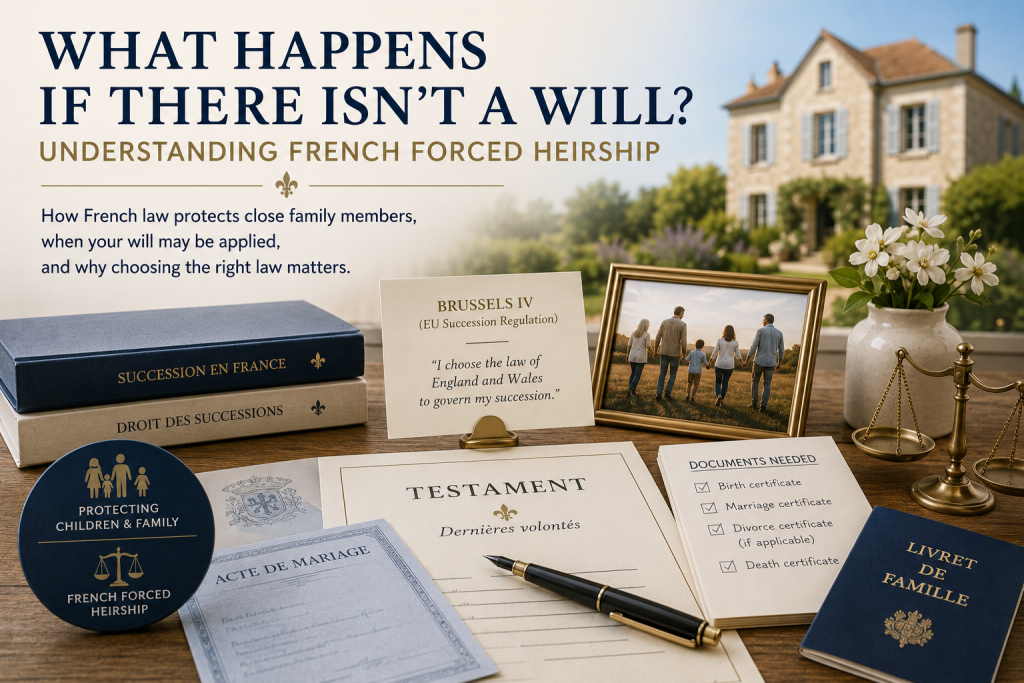
If your loved one owned property in France, you may hear the term "forced heirship." This guide explains what it means, when it applies, how Brussels IV can change the applicable succession law, and what happens if there is no will—or the will says very little.
One of the first questions many families ask is:
“Will my loved one’s will be followed?”
The answer depends on several factors.
Unlike England and Wales, France has traditionally operated a system known as forced heirship, where certain close family members have legal rights to inherit part of an estate regardless of what a will says.
However, for many British nationals, the situation changed significantly with the introduction of the EU Succession Regulation (Regulation (EU) No. 650/2012), commonly known as Brussels IV.
Understanding which law applies to the succession is one of the most important aspects of administering a French estate.
What Is Forced Heirship?
Forced heirship is a legal principle that reserves part of a person’s estate for certain close family members.
These protected beneficiaries are known as reserved heirs (héritiers réservataires).
In France, this protection primarily applies to children.
Historically, the system developed from the Napoleonic Code, with the aim of ensuring that children could not be completely disinherited and that wealth remained within the family.
How Much Is Reserved?
Under traditional French succession law:
| Children | Reserved Portion | Freely Disposable Portion |
|---|---|---|
| One child | 50% | 50% |
| Two children | Two-thirds | One-third |
| Three or more children | 75% | 25% |
The freely disposable portion (quotité disponible) may be left to anyone the deceased chooses.
Does Forced Heirship Always Apply?
No.
One of the biggest misconceptions is that owning property in France automatically means French forced heirship applies.
That isn’t necessarily true.
The law governing the succession depends on several factors, including:
- The deceased’s habitual residence.
- Whether a valid choice of law was made in a will.
- The circumstances of the estate.
This is where Brussels IV becomes particularly important.
What Is Brussels IV?
Brussels IV is the common name for the EU Succession Regulation (Regulation (EU) No. 650/2012).
Although the UK did not participate in the Regulation itself, France and most other EU countries apply it when dealing with international estates.
Article 22 allows a person to choose the succession law of their nationality to govern their estate.
For a British national, this usually means choosing the law of England and Wales, Scotland or Northern Ireland, depending on their nationality and domicile.
A typical clause might state that the person wishes the law of England and Wales to govern their succession.
This choice is normally made in a properly drafted will.
What If There Is No Will?
If there is no valid will, the applicable succession law will generally be determined under the relevant conflict-of-law rules, such as habitual residence under Brussels IV where applicable.
If French succession law governs the estate, French intestacy and forced heirship rules are likely to determine who inherits.
If English law governs the succession, the estate will generally be distributed according to the intestacy rules of England and Wales.
In other words:
- No will does not automatically mean French forced heirship.
- It depends on which succession law applies.
What If the Will Is Very Simple?
Some wills do little more than state:
“I elect the law of England and Wales to govern my succession.”
This is exactly how my father’s will was drafted.
Importantly, this type of clause chooses the applicable law, but it does not itself distribute the estate.
If the will contains no gifts or instructions about who should inherit, the estate will usually be administered under the intestacy rules of the chosen legal system.
In our case, that meant English intestacy rules became relevant because the will contained no provisions dealing with the distribution of the estate.
This is why it’s generally advisable for a will to contain both:
- a valid choice-of-law clause (where appropriate); and
- clear instructions about who should inherit.
Who Inherits Under English Intestacy?
If English and Welsh law applies but there are no effective gifts in the will, the intestacy rules determine who inherits.
The exact distribution depends on the family circumstances.
For example:
- A surviving spouse or civil partner has significant rights.
- Children also have statutory rights where applicable.
- If there is no surviving spouse or children, the estate passes through a statutory order of relatives.
Because these rules can be complex, it’s best to discuss your specific circumstances with your probate solicitor.
Why Does the Notaire Ask About Marriage and Divorce?
One of the first things your French notaire will establish is who the legal heirs are.
For that reason, they will often request:
- Birth certificate.
- Marriage certificate.
- Divorce certificate (if applicable).
- Death certificate.
- Family Record Book (Livret de Famille), if available.
Even if you divorced many years ago, the divorce remains relevant because it confirms that a former spouse no longer has inheritance rights that would otherwise arise from the marriage.
Providing these documents early can help avoid delays.
Common Misconceptions
“French property always follows French law.”
Not necessarily.
A valid Brussels IV choice-of-law election may result in another country’s succession law applying instead.
“A Brussels IV clause gives my estate away.”
No.
It simply determines which country’s succession law applies.
The actual distribution still depends on the contents of the will—or, if there are no effective gifts, the intestacy rules of that chosen law.
“Forced heirship means my spouse gets everything.”
Not necessarily.
French and English succession laws operate very differently.
Who inherits depends on which law governs the succession and the deceased’s family circumstances.
Practical Examples
Example 1 — No Will
A British national living in France dies without a will.
Depending on the applicable succession law, French intestacy and forced heirship rules may apply.
Example 2 — Full English Will
A British national owns a house in France.
Their will chooses English law under Brussels IV and leaves their estate equally between their three children.
French authorities will generally apply the chosen English succession law when administering the succession, subject to any applicable French mandatory rules.
Example 3 — Choice of Law Only
A will contains nothing except an Article 22 election stating that English law should apply.
The clause determines which law governs the succession, but because the will contains no gifts, the estate is generally distributed under the intestacy rules of England and Wales.
Final Thoughts
Forced heirship is often one of the most misunderstood aspects of French succession.
For many British families, the key question isn’t simply whether French forced heirship exists—it’s which succession law actually governs the estate.
A properly drafted will that clearly expresses both the testator’s wishes and, where appropriate, a valid Brussels IV choice of law can avoid significant uncertainty for those left behind.
If you’re dealing with a cross-border estate, ask your UK solicitor and French notaire to explain which succession law they believe applies and why. Understanding that answer will make many later stages of the succession much easier to follow.