Guide
Will I Have to Pay Inheritance Tax in Both the UK and France?
Many families worry they'll have to pay inheritance tax twice when a loved one leaves assets in both the UK and France. The good news is that a tax treaty exists to prevent double taxation—but understanding how it works can still be confusing. This guide explains what to expect and why your UK solicitor and French notaire may ask for very different information.
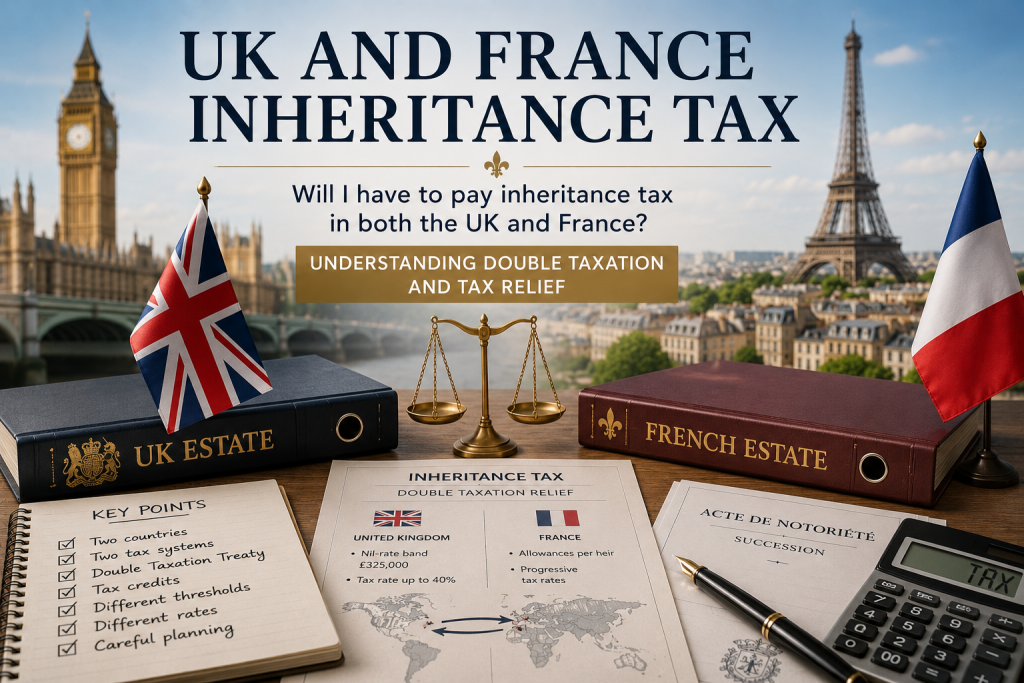
One of the biggest concerns during a cross-border succession is:
“Will we have to pay inheritance tax twice?”
The answer is often no, but the process can still feel as though you’re dealing with two completely separate tax systems.
Your UK solicitor and French notaire will usually both need information about the estate, and in many cases you’ll complete inheritance tax declarations in both countries.
Fortunately, the UK and France have a long-standing double taxation treaty designed to prevent the same assets being taxed twice.
Why Are Two Countries Interested?
The UK and France have very different inheritance tax systems.
Depending on the circumstances, both countries may have an interest in the estate because:
- Assets are located in both countries.
- The deceased lived in France.
- The deceased retained connections with the UK.
- The beneficiaries live in different countries.
This doesn’t automatically mean you’ll pay tax twice.
It does mean you’ll often have to provide information to both authorities.
Your UK Solicitor May Ask Unexpected Questions
If your loved one lived in France, your UK solicitor may ask questions that initially seem unusual.
For example:
- How long had they lived in France?
- Did they intend to return to the UK permanently?
- How often did they visit the UK?
- How many days did they spend there each year?
- Did they own or rent accommodation in the UK?
These questions help establish how UK inheritance tax rules apply and whether overseas assets should be brought into account.
In some cases, solicitors may ask whether you can provide evidence such as:
- Hotel bookings.
- Airline tickets.
- Ferry bookings.
- Passport stamps.
- Calendar records.
Don’t panic if these records no longer exist.
In our own case, we explained that reconstructing many years of travel would be impossible.
Instead, we provided an honest estimate based on what we knew—for example, that our father rarely returned to the UK and would typically spend no more than a few weeks there each year.
That explanation was accepted.
Every estate is different, but don’t assume you need perfect records going back decades.
France Usually Wants the Whole Picture
One aspect of French succession that surprises many UK families is that the French declaration often requires information about the deceased’s worldwide estate.
Your French notaire may therefore ask about:
- French property.
- UK property.
- UK bank accounts.
- Overseas investments.
- Vehicles.
- Other assets held around the world.
This doesn’t necessarily mean every asset will ultimately be taxed in France.
The declaration allows the notaire to establish the correct tax treatment under French law and any applicable tax treaty.
How Does Double Taxation Relief Work?
The UK and France have a specific inheritance tax treaty dating back to 1963.
Its purpose is to prevent the same asset being fully taxed twice.
In broad terms, where inheritance tax has already been paid on an asset in one country, the other country may give credit for that tax when calculating its own liability on the same asset.
This doesn’t always eliminate tax completely, but it does help avoid paying inheritance tax twice on the same value.
Because the treaty contains detailed rules about different categories of assets and where taxing rights sit, it’s important that your solicitor and notaire coordinate their work.
Why the Tax Bills May Still Look Different
Even though relief is available, don’t expect the UK and French calculations to look similar.
The two systems are fundamentally different.
Generally speaking:
United Kingdom
- Tax is calculated on the estate as a whole.
- The standard nil-rate band is currently £325,000, with additional reliefs available in some circumstances.
- Inheritance tax is generally charged at 40% on the taxable part of the estate.
France
- Tax is calculated separately for each beneficiary.
- Each beneficiary has their own tax-free allowance depending on their relationship to the deceased.
- Progressive tax rates apply after those allowances have been used.
Because the systems operate differently, the final tax position can vary considerably from one family to another.
Don’t Be Surprised by Questions About Gifts
Your UK probate forms may ask about gifts made during the years before death.
These same gifts may also attract the attention of your French notaire.
The two countries don’t always treat lifetime gifts in exactly the same way, so your notaire may ask for additional explanations or supporting documents.
If you’ve already prepared details for your UK solicitor, keep copies—you’ll often be able to reuse much of that information.
Keep Both Professionals Updated
One of the best things you can do is make sure your UK solicitor and French notaire are aware of each other’s involvement.
Providing each with copies of important documents can help avoid misunderstandings and reduce duplication of work.
If either professional asks for additional information about overseas assets, provide it as early as possible.
Cross-border estates almost always progress more smoothly when both advisers have a complete picture.
Final Thoughts
Although dealing with inheritance tax in two countries can seem intimidating, it doesn’t usually mean you’ll pay tax twice on the same assets.
The UK–France inheritance tax treaty exists to prevent double taxation, but applying it correctly still requires careful coordination between your UK solicitor and French notaire.
If you’re asked unusual questions about residence, travel history or overseas assets, remember that these are often necessary to determine which country’s tax rules apply and how relief should be claimed.
The more complete the information you can provide, the easier it will be for your advisers to administer the estate correctly.
For further information, you can look to:
→ French Inheritance Tax Explained (Allowances, Rates and Examples)