Guide
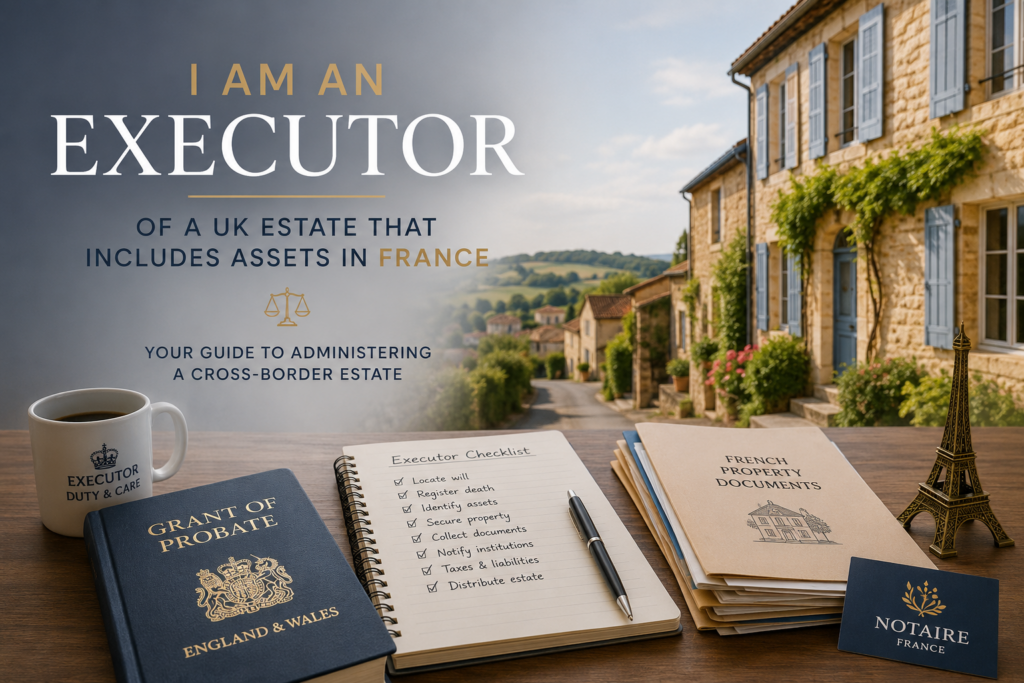
I Am an Executor of a UK Estate That Includes Assets in France
If you're the executor of a UK estate with assets in France, you'll need to navigate both UK probate and the French succession process. This guide explains your responsibilities, when to appoint a French notary, the documents you'll need, and how to administer a cross-border estate with confidence.
Being appointed as the executor of a loved one’s estate is a significant responsibility. When that estate includes property, bank accounts or other assets in France, the role becomes considerably more complex.
Many executors assume that obtaining probate in England and Wales gives them authority to deal with every asset worldwide. Unfortunately, that is not usually the case.
French assets are often governed by separate legal procedures and, where French property is involved, a French notary (notaire) will usually play a central role in administering that part of the estate.
The good news is that you do not need to become an expert in French law overnight. Understanding your responsibilities and knowing what to expect can make the process far less daunting.
Important: This guide is written for executors administering an estate in England and Wales that also contains assets in France. Scotland and Northern Ireland have different probate procedures.
What Does an Executor Do?
An executor is the person appointed in a will to administer the deceased’s estate.
Your responsibilities normally include:
- locating the original will;
- registering the death where required;
- identifying the deceased’s assets and liabilities;
- securing property;
- obtaining valuations;
- applying for probate if required;
- paying debts and taxes;
- dealing with beneficiaries; and
- distributing the estate according to the will.
When French assets are involved, these responsibilities remain, but some tasks will require assistance from professionals in France.
Does My Authority Extend to France?
Not automatically.
A Grant of Probate issued in England and Wales confirms your authority under English law to administer the estate. However, French authorities may require their own legal process before French assets can be transferred or sold.
For example:
- French bank accounts may require documentation requested by the bank.
- French property generally requires the involvement of a French notary.
- French inheritance tax obligations may arise even where UK probate has already been granted.
Think of the English Grant of Probate as one important piece of the overall administration rather than the final document needed for every country.
Your First Priorities
Before worrying about legal formalities, concentrate on protecting the estate.
You should try to:
- locate the original will;
- identify all beneficiaries;
- secure any French property;
- ensure buildings insurance remains valid;
- locate vehicle keys and documents;
- identify French bank accounts;
- obtain several official copies of the death certificate; and
- gather important paperwork.
The sooner you understand what assets exist, the easier the administration will become.
Find a French Notary Early
If the estate includes French property, appointing a suitable French notary should be one of your first steps.
The notary will usually:
- identify the legal heirs;
- prepare the acte de notoriété;
- deal with inheritance formalities;
- calculate inheritance tax where applicable;
- prepare property transfer documents; and
- complete registration formalities.
Choosing a notary familiar with British families and cross-border estates can significantly reduce delays.
Gather the Right Documents
One of the biggest causes of delay is incomplete documentation.
Depending on the estate, you may be asked for:
- the original will;
- the Grant of Probate;
- the death certificate;
- birth certificates;
- marriage or civil partnership certificates;
- divorce documents;
- passports;
- proof of address;
- property deeds;
- bank statements;
- trust documentation (if applicable);
- certified translations; and
- identification for each beneficiary.
Do not be surprised if the French notary requests documents that are unfamiliar in England and Wales. Often they are simply trying to establish facts that are proved differently under UK law.
Keep Beneficiaries Informed
Cross-border estates almost always take longer than domestic estates.
Delays may occur because of:
- document translation;
- obtaining certificates;
- correspondence with French institutions;
- property valuations;
- tax calculations;
- land registration; and
- differing legal procedures.
Regular updates help manage expectations and reduce misunderstandings.
Understand the Tax Position
Executors often assume that inheritance tax paid in one country means nothing further is due elsewhere.
Unfortunately, it is not always that simple.
Depending on the circumstances, there may be:
- UK Inheritance Tax;
- French inheritance tax;
- French property taxes;
- income tax;
- capital gains tax; or
- tax treaty considerations.
The existence of tax in one country does not automatically remove obligations in another.
Professional advice is strongly recommended where tax is involved.
Don’t Forget Practical Matters
Administration is not only about legal paperwork.
Someone may also need to:
- maintain the garden;
- secure vacant property;
- arrange cleaning or clearance;
- redirect post;
- deal with utilities;
- insure vehicles;
- locate spare keys;
- remove valuables;
- cancel subscriptions; and
- communicate with neighbours.
These practical jobs often need attention long before the legal administration is complete.
If There Are Trusts
Many British families have trusts created under wills or lifetime settlements.
French notaries may request additional information because trusts operate differently under English law.
You may need to provide:
- the trust deed;
- the relevant will;
- trustee details;
- legal opinions explaining the trust; and
- evidence of who is entitled to income or capital.
Providing these documents early can avoid lengthy correspondence later.
Common Mistakes Executors Make
Assuming UK probate automatically applies in France
It usually does not.
Waiting too long to appoint a French notary
Delays at the beginning often become much larger later.
Selling property too early
French property transfers usually require completion of the French succession process.
Not keeping records
Keep copies of every email, receipt, invoice and legal document.
Ignoring insurance
Vacant property may require different insurance arrangements.
Assuming every document needs translating
Always check with your French notary before paying for translations. Some documents may not require certified translation, while others almost certainly will.
A Suggested Order of Work
For many estates, the following sequence works well:
- Register the death and obtain certificates.
- Locate the original will.
- Secure all French property.
- Identify the assets.
- Contact a French notary.
- Gather the requested documents.
- Apply for probate in England and Wales if required.
- Deal with French succession formalities.
- Pay taxes and liabilities.
- Transfer or sell assets where appropriate.
- Prepare estate accounts.
- Distribute the estate.
Every estate is different, but following a structured approach helps avoid overlooking important tasks.
Final Thoughts
Being an executor is already a considerable responsibility. Administering an estate that spans two countries can feel overwhelming, particularly during a period of bereavement.
Fortunately, most cross-border estates follow a similar pattern. By securing the estate, appointing the right professionals early, gathering documents promptly and understanding that England and France each have their own legal procedures, the process becomes much more manageable.
Above all, remember that you do not need to solve every problem yourself. Your role as executor is to ensure the estate is administered correctly, seeking professional assistance whenever the complexity of the estate requires it.
Important Notice
This guide provides general information only and does not constitute legal, tax or financial advice. Every estate is different, particularly where multiple jurisdictions, trusts, foreign property or inheritance tax issues are involved. Executors should seek advice from appropriately qualified professionals where necessary.