Guide
Why French and UK Probate Feel So Different
Understand why French probate often feels so different from probate in England and Wales. This guide explains the role of French notaries, why the UK has no certificat de coutume, how executors and probate differ, and why cross-border successions often require different documents to prove the same legal facts.
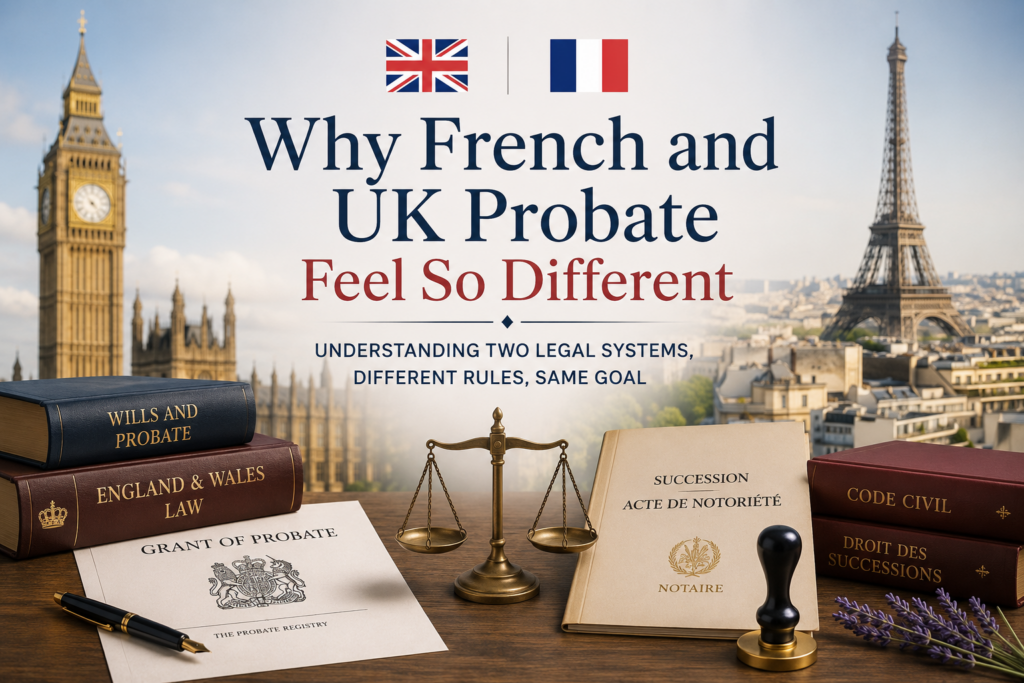
When a British family becomes involved in a French succession, it can sometimes feel as though the French notary and the UK solicitor are speaking completely different legal languages.
The French notary may request a document that does not exist in the UK. A UK solicitor may provide a legal explanation rather than the formal certificate the notary expected. Families may be asked for a livret de famille they have never possessed, or told that a notary must complete a procedure that an executor could ordinarily handle personally in England and Wales.
This does not necessarily mean that either professional is mistaken.
France and England and Wales operate under different legal traditions, give different responsibilities to legal professionals and use different methods to establish who is entitled to inherit.
Understanding those differences can make a cross-border succession much easier to navigate.
Important: This guide uses “UK probate” as a convenient general description, but its detailed comparisons primarily concern the law and procedure of England and Wales. Scotland and Northern Ireland have their own succession and probate systems.
France and England Have Different Legal Traditions
France operates primarily under a civil law system.
Its legal rules are organised principally through written codes, including the French Civil Code. The notary applies those statutory rules to establish the heirs, prepare the necessary formal acts and complete property and tax formalities.
England and Wales operate under a common law system.
The law is found not only in legislation but also in decisions made by the courts over many years. Previous judgments can help determine how legislation and legal principles should be interpreted in later cases.
This does not mean that French law is entirely written down while English law is not. Both systems use legislation, court decisions and legal interpretation. The difference is primarily one of legal structure, tradition and the relative importance given to different legal sources.
In practical terms, a French notary may expect a particular formal document confirming the applicable foreign law. An English solicitor or barrister may instead explain that law by referring to legislation, case law and the facts of the individual estate.
Who Administers an Estate in England and Wales?
In England and Wales, the estate is normally administered by one or more personal representatives.
Where there is a will, these will usually be the executors named in it. If there is no valid will, an eligible person may apply to become the administrator of the estate.
The personal representatives are responsible for tasks such as:
- valuing the estate;
- reporting and paying any tax due;
- applying for probate where required;
- collecting the deceased’s assets;
- paying debts and expenses; and
- distributing the remaining estate to the beneficiaries.
An executor can apply for probate personally. Hiring a solicitor or probate practitioner is optional in many estates, although professional support can be extremely valuable where the estate is complicated, disputed, taxable or includes overseas assets. GOV.UK expressly allows eligible executors to apply for probate themselves online or by post.
The Probate Registry issues the grant, but it does not ordinarily supervise every step of the estate administration. Responsibility for dealing with the estate rests substantially with the personal representatives.
What Does a French Notary Do?
A French notaire is not simply the French equivalent of a UK solicitor.
A notary is a publicly appointed legal professional who prepares and authenticates formal legal acts. In a succession, the notary may establish the identity of the heirs, determine their inheritance rights, prepare the acte de notoriété, calculate the estate, complete tax formalities and arrange the transfer or division of property.
The involvement of a French notary is mandatory where the succession includes French immovable property. Where there is no immovable property, notarial involvement may not always be legally compulsory, although it can still be necessary or advisable depending on the estate.
Notaires de France describes the settlement process as involving the establishment of the heirs through the notoriety act, preparation of a full estate assessment, completion of property and tax formalities, and determination of how the assets will be divided.
The notary is therefore performing a formal role within the French legal system. They are not merely advising the family about what to do.
Why Can Probate Be Handled Personally in England but Not in the Same Way in France?
This difference is sometimes described as France being less trusting of individuals. That is not a particularly accurate or helpful explanation.
It is better understood as a difference in where each legal system places responsibility.
In England and Wales, the executors or administrators are entrusted with administering the estate. They can carry out much of the work themselves, but they also assume significant legal responsibility for doing it correctly.
If they distribute the estate improperly, fail to pay a debt or tax, or act against the interests of the beneficiaries, they may become personally liable.
In France, many of the formal legal and property functions are instead placed in the hands of the notary. The notary must establish the legal position and produce the authentic acts needed to implement the succession.
It is not simply a distinction between a “high-trust” and a “low-trust” society. It is a difference between:
- a system that places much of the administrative responsibility directly upon the personal representatives; and
- a system that assigns important formal functions to a public legal officer.
Both systems require evidence and both can impose serious consequences when an estate is handled incorrectly. They simply organise the process differently.
Why Does France Ask for So Many Civil Status Documents?
A French notary must establish who the deceased was, whether they were married or divorced, whether they had children, whether any previous spouse has died and who is legally entitled to inherit.
For a French family, much of this information may be recorded in or supported by documents such as the livret de famille and recent civil-status certificates.
A British family will probably not have a livret de famille. Instead, they may need to assemble the same chain of evidence using separate documents, including:
- full birth certificates;
- marriage or civil partnership certificates;
- divorce documents;
- death certificates for former spouses;
- birth certificates for children; and
- other evidence of family relationships.
The objective is not necessarily to demand a particular British document. It is to prove the facts that the French document would ordinarily have established.
This distinction can prevent a great deal of frustration. When a notary asks for a document that does not exist in the UK, the most useful question is often:
What fact or legal conclusion is this document intended to prove?
Once that is understood, it may be possible to provide an appropriate British alternative.
What Is a Certificat de Coutume?
A certificat de coutume is a statement or certificate explaining the relevant rules of a foreign legal system.
It may be requested where a French authority or notary needs to understand how another country’s law applies to a particular person, document, relationship or estate.
Despite its literal translation as a “certificate of custom”, it is not usually about social customs. It concerns the content and application of foreign law.
For example, a French notary might request one to confirm:
- who has authority to administer an English estate;
- what rights an executor possesses;
- whether a particular document is valid under English law;
- how a trust operates;
- who owns the capital held within a trust; or
- whether a beneficiary has a vested or merely life interest.
Why Does the UK Not Issue a Standard Certificat de Coutume?
There is no single UK government department that routinely issues a universal document called a certificat de coutume for every foreign legal request.
There is also no standard government certificate that can explain every aspect of English succession or trust law.
This is partly because foreign-law questions are highly dependent upon the particular facts.
For example, understanding a trust may require examination of:
- the trust deed;
- the will that created the trust;
- later deeds of appointment or variation;
- the identity of the trustees;
- the rights of the life tenant;
- the rights of the capital beneficiaries; and
- the relevant principles of English trust law.
A generic government certificate could not reliably answer all of those questions.
Instead, the relevant English law may be evidenced through a formal legal opinion, declaration or explanatory letter prepared by a suitably qualified solicitor, barrister or notary.
That professional may identify the relevant documents and explain how English law applies to the facts.
Can a UK Solicitor Provide the Equivalent?
A UK solicitor may be able to provide a legal opinion or declaration that serves the practical purpose for which the certificat de coutume was requested.
However, it should not simply state:
“The UK does not issue this document.”
A useful legal opinion should clearly explain the legal conclusions the French notary needs to rely upon.
For example, in a trust matter it might confirm:
- how the trust was created;
- who the trustees and beneficiaries are;
- whether the deceased held any beneficial interest;
- whether the deceased was entitled only to income;
- whether the deceased ever became entitled to the trust capital;
- what happened to the trust interest upon death; and
- which documents establish those conclusions.
The French notary may still ask questions or request further evidence. This does not necessarily mean the legal opinion has been rejected. The notary may need the wording to address a precise point required for the French succession declaration or tax treatment.
UK Solicitors and French Notaries Do Not Perform the Same Function
This is one of the most important differences to understand.
A UK solicitor is a regulated legal adviser who can:
- advise clients;
- interpret legislation and case law;
- prepare legal documents;
- conduct probate work;
- correspond with authorities; and
- represent clients in legal matters.
A French notary performs legal advisory work too, but also has an official role in preparing authentic legal acts.
An English solicitor’s letter does not automatically become the equivalent of a French notarial act merely because it has been written by a lawyer.
Equally, a French notary may not be able to give a definitive interpretation of a complicated English trust without relying upon advice from a professional qualified in English law.
Cross-border succession often requires the two professionals to perform complementary rather than identical roles.
Why Do Trusts Cause Particular Difficulty?
Trusts are a central feature of English law, but they do not fit neatly into traditional French property concepts.
Under a typical English trust, the legal title to an asset may be held by the trustees while the economic or beneficial rights belong to one or more beneficiaries.
Those beneficiaries may themselves have different types of interest. One person may be entitled to receive income during their lifetime, while others become entitled to the underlying capital later.
This separation between legal ownership, income rights and capital rights can be unfamiliar when viewed through the categories normally used in a French succession.
The French notary may therefore need to determine:
- whether the deceased legally owned the asset;
- whether the deceased was merely a trustee;
- whether the deceased received income from the trust;
- whether the deceased had any right to the capital;
- whether that interest ended at death; and
- whether any value should be included in the French succession or tax declaration.
The trust deed alone may not answer every question clearly for someone unfamiliar with English trust terminology. A supporting legal opinion can be particularly valuable.
Forced Heirship and Testamentary Freedom
The two legal systems also approach wills and inheritance rights differently.
French law protects certain close family members through the réserve héréditaire, commonly translated as the hereditary reserve or forced-heirship share.
Children are generally reserved heirs. A portion of the estate is protected for them, while only the remaining quotité disponible can be freely left to other people. Notaires de France describes children, or in certain circumstances a spouse, as reserved heirs whose protected share limits what can be given away outside the reserved portion.
England and Wales traditionally provides much greater testamentary freedom. A person may generally leave their estate to the people or organisations they choose.
That freedom is not absolute. Certain spouses, partners, children, dependants and others may ask the court for reasonable financial provision under the Inheritance (Provision for Family and Dependants) Act 1975.
The distinction is therefore not simply:
- France has rules; and
- England has none.
Rather:
- French law generally protects reserved heirs automatically through the structure of succession law; while
- English law generally gives wider freedom under the will, subject to eligible people being able to bring a claim in appropriate circumstances.
Why Can Both Countries Appear to Apply Different Rules to the Same Estate?
A cross-border estate may involve several separate questions:
- Which country’s succession law applies?
- Where was the deceased habitually resident?
- Did the will contain a choice of law?
- Where is each asset situated?
- Which country may tax the asset?
- Which authority can transfer or register the property?
- How should a trust or lifetime gift be treated?
The answer may not be identical for every asset or every purpose.
For example, English law may determine who has authority to administer an English estate, while a French notary is still required to complete the formal transfer of French land.
Similarly, the law governing succession and the law governing inheritance tax are related but separate questions. A choice of English law in a will does not automatically remove French tax obligations.
This is why statements such as “English law applies” or “the estate has already gone through probate in the UK” may not, by themselves, resolve the French procedure.
Why Does Communication Break Down?
Many difficulties arise not because either side is refusing to cooperate, but because each side assumes the other uses familiar legal concepts.
A French notary may ask:
Please provide the family record book.
The British family replies:
We do not have one.
The notary may interpret that as a missing document, while the family interprets it as an impossible request.
The real issue is that the notary needs evidence of the deceased’s marriage and children.
Similarly, the notary may request a certificat de coutume, while the solicitor responds that no such official UK certificate exists.
The underlying requirement may actually be a formal explanation of:
- the executors’ authority;
- the effect of the will;
- the ownership of an asset; or
- the operation of a trust.
A productive response should therefore explain both why the requested document is unavailable and what alternative evidence can prove the same point.
Practical Ways to Reduce Misunderstandings
Ask what the document is intended to prove
Do not stop at the name of the document. Ask the notary which fact or legal conclusion they require.
Explain UK equivalents clearly
Rather than simply saying that the document does not exist, explain what the UK uses instead.
For example:
The United Kingdom does not issue a family record book. The equivalent family relationships are proved through individual birth, marriage, divorce and death certificates.
Ask for precise questions for the UK lawyer
Where an English solicitor’s opinion is needed, ask the French notary to identify the exact legal points that must be addressed.
This can prevent a broad legal letter being produced only for the notary to say that it does not answer the required question.
Avoid direct translations without explanation
Legal terms rarely have perfect one-to-one translations.
Words such as executor, administrator, trustee, beneficial owner, usufructuary and notaire may need a short explanation rather than a literal translated label.
Keep the supporting documents together
A legal opinion should usually be supplied alongside the documents upon which it relies, such as the will, trust deed, grant of probate or appointment of trustees.
Use professionals familiar with cross-border estates
A solicitor who understands English probate but has never dealt with France may not anticipate the form of explanation a French notary requires.
Likewise, a French notary who rarely handles British estates may be unfamiliar with executors, English trusts and UK civil-status records.
Experience with both systems can significantly reduce delay.
Neither Legal System Is Necessarily Wrong
It is understandable to feel frustrated when one professional asks for a document that another professional says does not exist.
However, the apparent contradiction often arises because the professionals are trying to reach the same destination through different legal routes.
The French notary needs reliable evidence before preparing formal succession and property acts.
The English executor or solicitor may be accustomed to proving the same legal position through a grant of probate, original records and a reasoned legal opinion.
The key is not to reproduce a French document that the UK does not issue. It is to identify the purpose behind the request and provide evidence that achieves the same legal result.
Final Thoughts
French and English probate feel different because they are built around different legal structures.
In England and Wales, personal representatives can take direct responsibility for administering an estate and can apply for probate without appointing a solicitor.
In France, the notary has a central formal role, particularly where the estate contains immovable property.
A request for a livret de famille, certificat de coutume or other unfamiliar document does not always mean that the exact French document must somehow be obtained in Britain.
Often, the real task is to establish what the document would have proved and then provide the appropriate British evidence, supported where necessary by a clear legal opinion.
Approached in that way, many apparent conflicts between the two legal systems become problems of translation, evidence and legal function rather than genuine disagreements about the law.