Guide
How to translate UK documents for France
Need to translate UK documents for use in France? This guide explains the different types of translators, why sworn or certified translations are often required, how to find a qualified translator, and what to expect during a French succession.
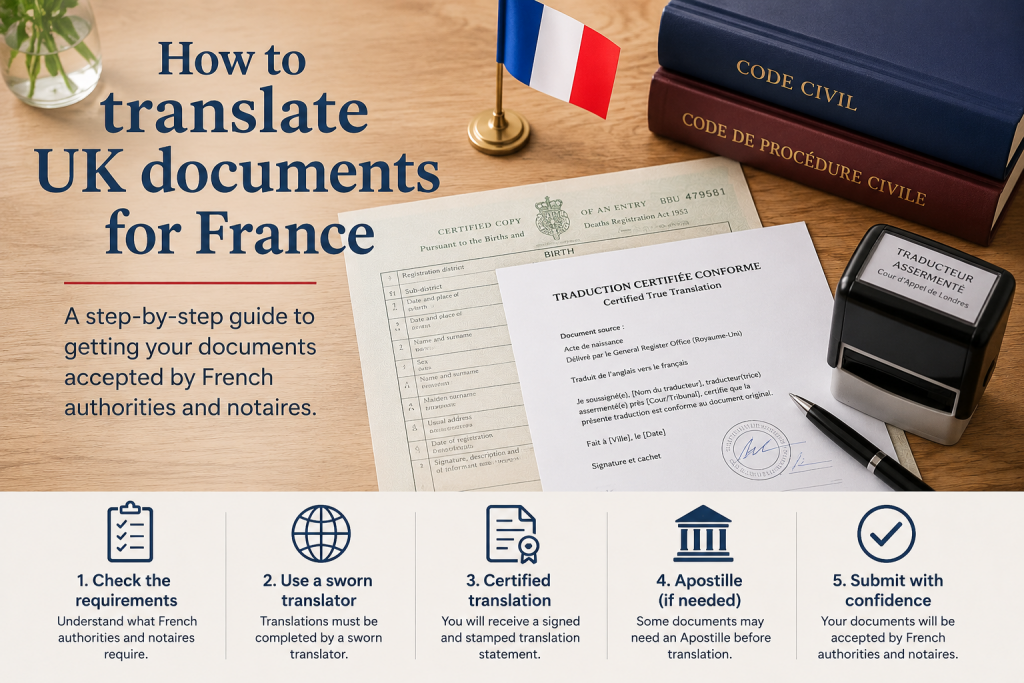
If you’re dealing with a French succession or cross-border probate, you’ll almost certainly need official documents translated between English and French.
Choosing the right translator is important. Submitting documents translated by someone who isn’t suitably qualified can lead to delays, additional costs and requests to have the documents translated again.
This guide explains the different types of translators, how to choose the right one and where to find qualified professionals.
Why Do Documents Need Translating?
French notaires and government authorities generally require official documents to be provided in French.
Similarly, during the administration of an estate you may receive French legal documents that need translating into English so that beneficiaries understand what they are signing.
Common documents requiring translation include:
- Birth certificates
- Marriage certificates
- Death certificates
- Wills
- Grants of Probate
- Letters of Administration
- Trust documentation
- Notarial correspondence
- Succession declarations
- Property documents
- Tax documents
- Identity documents
Translation is therefore often required throughout the succession process—not just at the beginning.
Understanding the Different Types of Translator
Not every translator is recognised for official legal work.
You’ll commonly encounter three descriptions.
Standard Translator
A professional translator may be perfectly capable of producing an accurate translation but has no official legal recognition for certifying documents.
These translations are generally suitable for personal or informal use but are often not accepted by notaires or government authorities.
Certified Translator
A certified translator provides a signed declaration confirming that the translation is accurate and complete.
Many organisations accept certified translations for official purposes, particularly within the UK.
These are commonly used for legal and administrative documents.
Sworn Translator (Traducteur Assermenté)
A sworn translator has taken an official oath before a court or other recognised authority.
Their translations carry legal standing and are frequently required for documents submitted to French authorities and courts.
For many French legal procedures, a sworn translation is the safest option.
Which Should You Choose?
For a French succession, you should generally look for translators offering Certified and/or Sworn translation services.
We recommend avoiding translators who only offer standard translation services for legal documentation.
Where possible, choose a translator who can provide both Certified and Sworn translations.
Although not every document requires the highest level of certification, requirements can vary depending on:
- The receiving authority
- The type of document
- Whether the document is being used in the UK or France
- Whether it is required by a notaire, court or another organisation
Working with a translator who offers both services means you are less likely to need to find another translator later in the succession.
Finding a Translator
The UK Government maintains a directory of professional translators and interpreters operating overseas.
You can search the directory here:
When reviewing the listings, pay particular attention to the services each translator offers.
We recommend selecting only translators who specifically advertise Sworn and/or Certified translation services.
If a listing only refers to general translation work without indicating certification or sworn status, it may not be appropriate for official succession documents.
Recommended
I would recommend from my experience:
Company: https://www.efficientranslations.fr/
Name: Eloisa Thomas
Email: eloisa@efficientranslations.fr
Description: Eloisa provided simple pricing, she was very timely and fast to turn around translations, can provide both Sworn or certified translations and is a brilliant professional to work with.
Before Instructing a Translator
Before sending any documents, it’s worth contacting the translator to confirm a few details.
Ask:
- Are you currently accepting new work?
- Do you provide sworn translations?
- Do you provide certified translations?
- What are your current turnaround times?
- What are your fees?
- Do you charge per page or per word?
- Can documents be supplied electronically?
- Do you post original certified copies if required?
This short conversation can avoid delays later in the process.
Think Ahead
Many families assume they’ll only need one or two translations.
In reality, translation requirements often continue throughout both the UK probate process and the French succession.
As your estate progresses, you may need translations in both directions:
English → French
Examples include:
- Birth certificates
- Marriage certificates
- Grants of Probate
- Wills
- Trust documentation
- Identity documents
French → English
Examples include:
- Notaire correspondence
- Succession documents
- Property paperwork
- Tax documentation
- Requests from French authorities
- Legal agreements
Choosing a translator who is familiar with cross-border probate and succession work can make the entire process much smoother.
Building a Long-Term Relationship
If your succession is likely to take many months—as many UK–France estates do—it is often beneficial to continue working with the same translator.
Using one translator throughout the process provides:
- Consistent terminology
- Familiarity with your case
- Faster turnaround on future documents
- Reduced administration
- A single point of contact
Many translators also retain previous translations, making future work quicker and more consistent.
Using AI to Help with Everyday Translation
Not every document or communication needs a professional translator.
If you’re simply trying to understand an email from your notaire or draft a reply, modern AI tools can be extremely helpful and can save both time and money.
Translating Emails
For routine correspondence, tools such as ChatGPT can produce excellent translations.
We recommend the following approach:
- Write your email in English first.
- Ask ChatGPT to improve the wording if you’d like it to sound more formal or professional.
- Ask ChatGPT to translate the final version into French.
- Ask ChatGPT to translate the French version back into English.
- Read the translated English version to make sure it still conveys exactly what you intended.
- Make any necessary changes and repeat the process if required.
This gives you confidence that the meaning hasn’t unintentionally changed during translation.
Include Both Languages
When emailing French professionals, it can often be helpful to include both versions of your message.
For example:
<French version>

----------------------------------
In English
----------------------------------

<English version>
Including the original English text helps avoid misunderstandings if any wording is interpreted differently during translation and can make it easier for bilingual professionals to clarify any ambiguity.
Reviewing Documents with AI
If you’ve received a French document that does not require an official translation and you simply want to understand its contents, AI translation tools can be extremely useful.
For example, you may receive:
- Routine correspondence from your notaire
- Draft legal documents
- Property information
- Administrative letters
- Tax correspondence
These documents often don’t need to be professionally translated unless they’re being submitted to an authority or relied upon as an official translation.
Tools such as ChatGPT and DeepL can provide an excellent understanding of the content for personal review.
DeepL is particularly useful because it allows entire PDF documents to be translated while preserving much of the original formatting.
Important: AI-generated translations should only be used to help you understand documents. They should not be submitted to a French notaire, court or government authority in place of a certified or sworn translation where one is required.
Final Thoughts
Professional translation is an essential part of many French succession cases.
Choosing a qualified translator from the outset can prevent unnecessary delays and help ensure your documents are accepted the first time.
Where possible, choose a translator who offers Certified and Sworn translation services, confirm their availability before sending documents and remember that you’ll likely require translations in both English and French as the succession progresses.
Need Help?
If you’re unsure whether a document requires translation, what level of translation is needed or how to find a suitable translator, our Document Gathering & Preparation and Consultation & Succession Guidance services can help you understand what’s required and point you towards appropriate professionals for your circumstances.