Guide
Contacting French Banks After a Death
Learn how to notify French banks following a bereavement, how to identify your loved one's accounts, what documents you'll need, and why contacting banks as soon as possible can help protect the estate.
One of the first practical tasks following a death in France is notifying your loved one’s bank or banks.
Unlike the UK, there is no single central notification service that informs all banks of a death on your behalf.
Instead, you’ll normally need to contact each French bank individually.
This can be one of the more frustrating parts of the succession, particularly if your loved one never told you where they banked.
Before You Call the Bank
Before making your first call, it’s worth gathering as much information as possible. Having everything to hand will make the conversation much smoother and reduce the likelihood of needing to call back.
Ideally, you should have:
- ✓ Your loved one’s full name.
- ✓ Their date of birth.
- ✓ Their last known address in France.
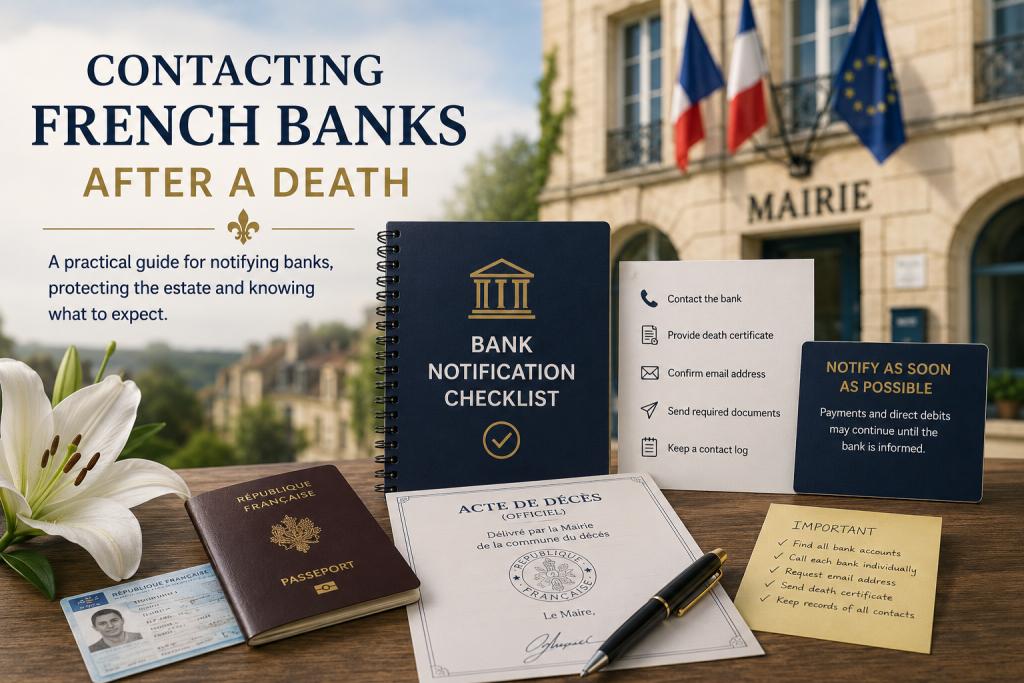
- ✓ The official French death certificate (Acte de Décès), or the preliminary medical certificate if you’re still waiting for the official document.
- ✓ Your own passport or photo identification.
- ✓ Your email address, ready to provide over the phone.
- ✓ A pen and paper (or a notes app) to record names, reference numbers and any instructions.
- ✓ Any account numbers, bank cards, cheque books or correspondence you’ve already found.
If English-speaking staff are unavailable, don’t worry. Many conversations are relatively short, and the bank will often ask you to send supporting documents by email after the initial call. Preparing a few translated phrases in advance (see below) can also make the conversation much less stressful, see our phrases list provided at the end of this article.
Contact the Banks as Soon as Possible
You should contact each bank as soon as reasonably possible after the death.
Although the succession itself may take many months, informing the bank early allows them to place the appropriate restrictions on the account and begin their own internal procedures.
If notification is delayed, standing orders, direct debits and other payments may continue leaving the account until the bank has been informed.
Keep a Contact Log
Throughout the succession you’ll likely be dealing with dozens of organisations over several months.
It’s surprisingly easy to forget who you’ve spoken to, what documents you’ve sent or whether you’re still waiting for a response.
Keeping a simple contact log can make the entire process much easier to manage.
For each organisation, record:
- ✓ Date and time of the conversation.
- ✓ Name of the organisation.
- ✓ Name of the person you spoke with.
- ✓ Telephone number or email address.
- ✓ Any reference or case numbers.
- ✓ What was discussed.
- ✓ What documents they requested.
- ✓ When you sent those documents.
- ✓ Whether any further action is required.
- ✓ The date you should follow up if you haven’t heard back.
Even a basic spreadsheet or notebook can become one of your most valuable organisational tools.
During our own succession, there were many occasions where organisations asked when we had last contacted them or what information had already been provided. Having a written record meant we could answer confidently, avoid duplicating work and ensure nothing important was overlooked.
As your succession progresses, you’ll likely find yourself referring back to your contact log regularly. Spending a few minutes updating it after every telephone call or email can save hours of confusion later.
Check out our resource workbook which includes a contact log.
Finding Your Loved One’s Bank
Sometimes this is straightforward.
Other times it can be surprisingly difficult.
Useful places to check include:
- Bank cards.
- Cheque books.
- Filed correspondence.
- Online banking records.
- Direct debit paperwork.
- Property paperwork.
If you cannot identify every bank immediately, don’t panic.
Begin with those you do know and continue searching while the succession progresses.
One common French bank is Crédit Agricole, particularly in rural areas, although your loved one may have banked elsewhere.
Telephone Is Usually Best
Although many banks eventually communicate by email, the quickest way to begin the process is usually by telephone.
Explain that your loved one has died and ask what documentation they require.
Once you’ve made contact, request an email address so you can send the necessary documents.
Ask for Their Email Address
One practical tip is to ask for an email address during your first telephone conversation.
You’ll usually need this to send:
- The official French death certificate.
- Identity documents.
- Any forms requested by the bank.
Because email addresses can easily be misunderstood over the telephone, particularly across different accents and languages, repeat the address back carefully.
If possible, send a short test email while you’re still on the phone and ask the adviser to confirm that they’ve received it.
This simple step can prevent delays later.
The Death Certificate
The bank will normally ask you to provide the official French death certificate (Acte de Décès).
If you haven’t obtained this yet, see our guide:
→ How to Obtain a French Death Certificate
Most banks won’t begin processing the notification until they’ve received the death certificate.
Don’t Expect Detailed Financial Information
Many families are surprised that the bank will not discuss account balances or provide bank statements immediately.
This is entirely normal.
Until the succession has progressed and the notaire has established who is legally entitled to receive information, banks are generally unable to disclose detailed financial information.
Your notaire will usually obtain the financial information required for the succession directly from the banks.
Your responsibility is primarily to notify the bank that your loved one has died.
Your Notaire’s Role
Although the notaire will deal with the succession itself, they do not usually telephone each bank immediately after the death to notify them.
This is something you’ll generally need to do yourself.
Later in the succession, the notaire will request the financial information needed to prepare the succession documents.
If You Don’t Know All the Accounts
If you’re struggling to identify every bank account, your notaire or avocat can request searches of official French registers.
These include:
FICOBA
The national register of French bank accounts.
This helps identify accounts held by the deceased.
FICOVIE
The register of life insurance policies.
This identifies many life insurance contracts that may otherwise be overlooked.
If you’re concerned that accounts or policies may have been missed, ask your notaire or avocat whether requesting these searches would be appropriate.
Useful French Telephone Phrases
| English | French | Pronunciation |
|---|---|---|
| Hello, my name is… | Bonjour, je m’appelle… | bon-zhoor, zhuh mah-pell… |
| I’m calling because my father/mother has died. | J’appelle parce que mon père / ma mère est décédé(e). | zhah-pell parss kuh mon pair / mah mair ay day-say-day |
| I need to notify the bank. | Je souhaite informer la banque du décès. | zhuh soo-et an-for-may lah bonk dew day-say |
| What documents do you need? | De quels documents avez-vous besoin ? | duh kel dok-yoo-mon ah-vay voo buh-zwan |
| Could I have your email address? | Puis-je avoir votre adresse e-mail ? | pwee zhah-vwar votr ah-dress ee-mail |
| Could you repeat that, please? | Pouvez-vous répéter, s’il vous plaît ? | poo-vay voo ray-pay-tay seel voo play |
| I’ve just sent a test email. Have you received it? | Je viens de vous envoyer un e-mail de test. L’avez-vous reçu ? | zhuh vee-an duh voo on-voy-yay un ee-mail duh test. lah-vay voo ruh-soo |
| Thank you for your help. | Merci pour votre aide. | mair-see poor votr ed |
Final Thoughts
Contacting French banks is rarely the most complicated part of a succession, but it is often one of the most time-sensitive.
Notify each bank as soon as possible, obtain an email address, send the official death certificate promptly and allow your notaire to deal with obtaining balances and financial information later in the succession.
If you’re unable to identify all of your loved one’s accounts, don’t hesitate to ask your notaire or avocat about searches of the FICOBA and FICOVIE registers.