Guide
How to Discover Your Loved One’s Assets
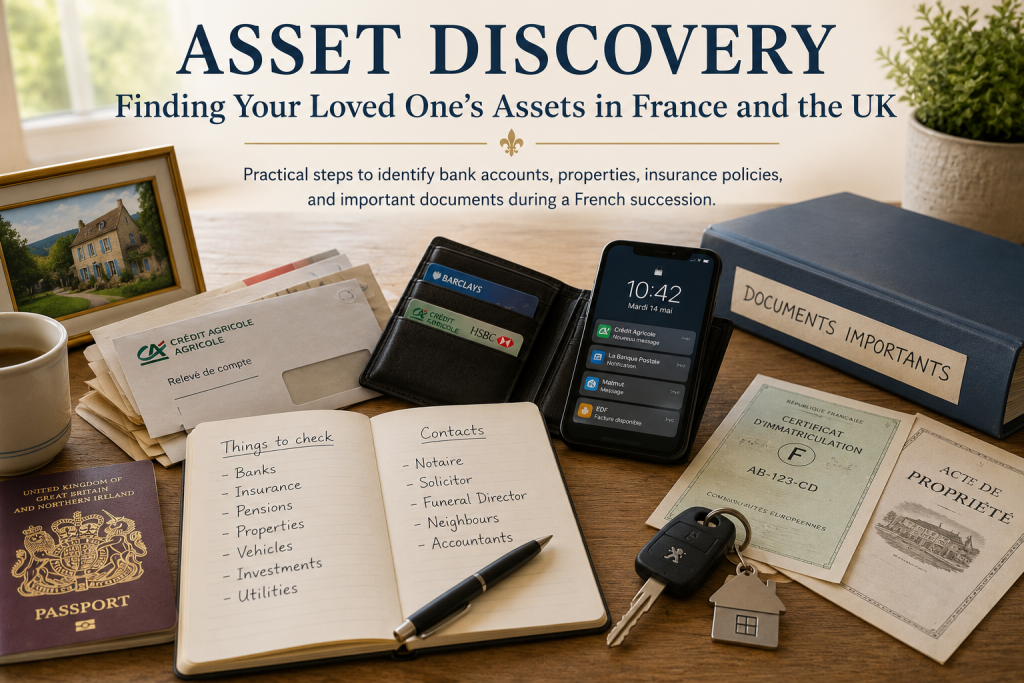
One of the biggest challenges during a French succession is identifying everything your loved one owned. This guide explains practical ways to discover bank accounts, property, insurance policies, vehicles and important documents when little information has been left behind.
One of the first questions every family asks is:
“How do we know what they actually owned?”
Unfortunately, there is rarely a single document listing every bank account, insurance policy, property and investment.
Instead, discovering your loved one’s assets often becomes a process of careful investigation.
The sooner you begin, the easier many later stages of the succession become.
Start with the Funeral Director
Your first point of contact should usually be the funeral director.
If you haven’t already, read our guide:
→ Working with Funeral Directors in France
Ask whether any personal belongings were recovered with your loved one.
In particular, ask about:
- Mobile phone.
- Wallet or purse.
- House keys.
- Car keys.
- Handbag.
- Identity documents.
- Glasses.
- Personal paperwork.
Recovering these items can provide valuable clues.
Bank Cards Tell a Story
One of the simplest ways to identify bank accounts is by examining the bank cards found in your loved one’s wallet.
Each card immediately tells you which financial institution should be contacted.
This allows you to:
- Notify the bank of the death.
- Request the account be appropriately restricted.
- Inform your notaire which banks held accounts.
Don’t forget UK banks as well.
Many people living in France continue to maintain UK accounts, so check for both French and British bank cards.
Check the Mail
If you’re able to visit the property, spend time carefully reviewing the post.
Letters often reveal:
- Bank statements.
- Insurance providers.
- Pension providers.
- Investment companies.
- Utility providers.
- Tax correspondence.
- Healthcare providers.
During our own succession, this was how we discovered both bank accounts and my father’s health insurance provider.
Even seemingly routine letters can become valuable pieces of the puzzle.
Ask the Neighbours
Neighbours can often be one of your greatest sources of information.
If you don’t know who they are, ask the funeral director whether they know the neighbouring properties or can help introduce you.
In our own experience, neighbours proved incredibly helpful.
One neighbour informed us that my father’s car was actually at a local mechanic for repairs.
Without that conversation, we may not have discovered where the vehicle was for quite some time.
Neighbours may also know about:
- Holiday homes.
- Garages.
- Vehicles.
- Local tradespeople.
- Family friends.
- Property issues.
- Recent purchases.
FICOBA and FICOVIE
If you’re struggling to identify financial assets, ask your notaire or avocat whether they can request searches of:
FICOBA
France’s register of bank accounts.
This helps identify French bank accounts held by the deceased.
FICOVIE
France’s register of life insurance policies.
This identifies many life insurance contracts that might otherwise be overlooked.
These searches are extremely useful, but they won’t identify every type of asset.
Don’t Forget the Mobile Phone
A mobile phone can be incredibly valuable.
Even if it’s locked, notifications may reveal:
- Banks.
- Utility providers.
- Email addresses.
- Insurance companies.
- Family contacts.
- Appointment reminders.
If the phone is protected by a PIN or passcode, avoid repeatedly entering incorrect codes.
Many modern phones permanently increase security measures after multiple failed attempts and some eventually require a complete factory reset, resulting in the loss of locally stored data.
If you happen to know that your loved one used a very simple PIN, that’s different—but if you’re unsure, it’s generally better to seek advice before attempting to unlock the device.
Property Searches
If you’re uncertain which properties your loved one owned, speak with your notaire or avocat.
Unlike the UK, France does not have a single publicly searchable ownership register.
Instead, land records are generally organised geographically, and searches often need to be directed towards the areas where your loved one is believed to have owned property.
Property records primarily record legal transactions rather than providing a simple nationwide list of everything a person owns.
As a result, establishing ownership can sometimes involve reviewing transaction histories and identifying properties that were purchased but never subsequently sold.
Look for Important Documents
While searching the property, try to locate:
- Property deeds.
- Vehicle registration certificates.
- Insurance policies.
- Pension paperwork.
- Mortgage documents.
- Tax correspondence.
- Investment statements.
- Utility bills.
- Previous wills.
- Safe keys.
- Digital password records.
Don’t throw paperwork away until you’ve checked it carefully.
Documents that appear insignificant often become important later.
Speak to Family Members
Other family members may remember things you don’t.
Ask whether they know about:
- Old pensions.
- Previous addresses.
- Holiday homes.
- Storage units.
- Safe deposit boxes.
- Vehicles.
- Investments.
- Military or occupational pensions.
Even small pieces of information can lead to significant discoveries.
Be Patient
One of the most frustrating aspects of asset discovery is that you won’t immediately have access to everything.
For example, banks will rarely provide account balances before the succession has progressed sufficiently for the notaire to establish the legal heirs.
Identifying assets is therefore often an ongoing process rather than a single task.
Keep notes, update your contact log and continue adding information as new discoveries are made.
Think Ahead
Having experienced this process myself, one lesson stands out above all others.
Everyone should consider preparing a personal “Book of Affairs.”
This doesn’t need to contain passwords or sensitive financial information.
Instead, it can simply list:
- Banks.
- Insurance providers.
- Pensions.
- Properties.
- Vehicles.
- Solicitors.
- Notaires.
- Utility providers.
- Funeral wishes.
- Where important documents are kept.
Leaving this information for your family can save them weeks or even months of unnecessary investigation during an already difficult time.
Final Thoughts
Asset discovery is often like assembling a jigsaw puzzle.
No single organisation has every answer.
Instead, you’ll gradually build a complete picture by speaking with professionals, checking paperwork, asking neighbours, reviewing personal belongings and following each clue as it appears.
Although it can take time, a thorough investigation at the beginning of the succession will make almost every later stage significantly easier.