Guide
Don’t Forget French Property Taxes
One of the easiest things to overlook after a death is the ongoing property taxes. Once bank accounts are frozen, automatic payments may stop, leading to unpaid tax bills and unnecessary penalties. This guide explains what you should do and who to contact.
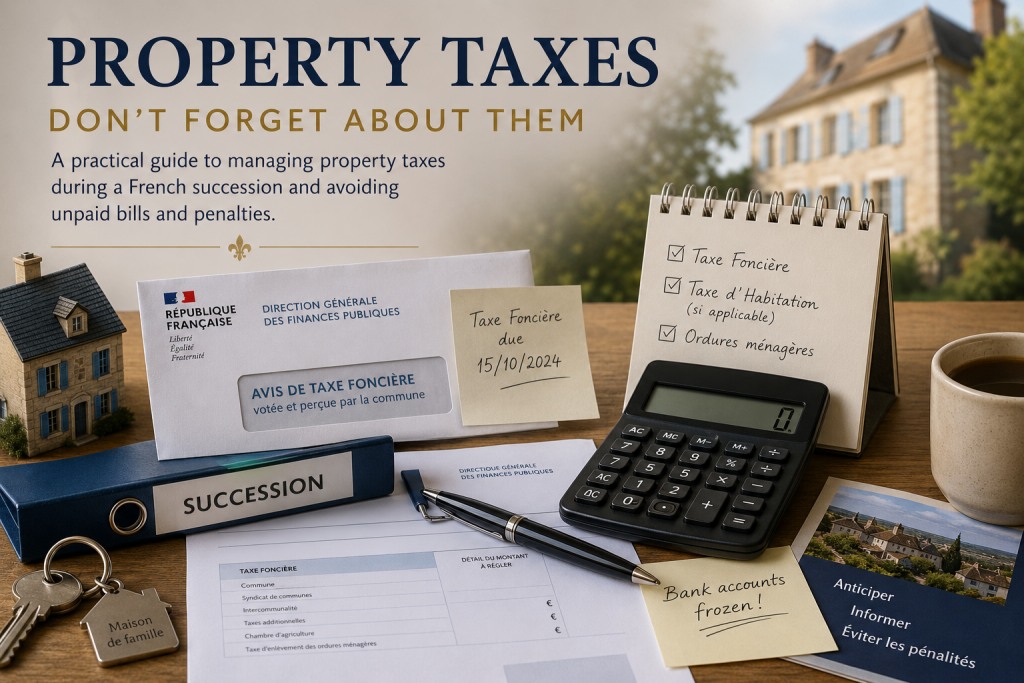
During the early stages of a French succession, it’s easy to focus on funeral arrangements, notaires and bank accounts.
However, one important responsibility that is often overlooked is the ongoing property taxes associated with your loved one’s home.
Unlike many one-off costs, these taxes continue to fall due even after death.
Why This Matters
One of the first things you’ll usually do is notify your loved one’s banks of their death.
Once notified, banks typically restrict or freeze access to the account while the succession is administered.
Although this protects the estate, it also means that existing direct debits and automatic payments may no longer be honoured.
If the annual property tax is due during this period, it may go unpaid.
For this reason, don’t assume that because the property is part of the succession, the tax authorities will automatically know what has happened.
What Taxes Might Still Be Due?
Depending on the property and circumstances, you may encounter:
- Taxe Foncière (Property Ownership Tax)
- Taxe d’Habitation (Residence Tax) in situations where it still applies, such as certain second homes.
- Local waste collection charges that may appear alongside the property tax.
Your notaire will usually deal with these liabilities as part of the succession, but it is still sensible to make sure the tax authorities are aware of the death and know who to contact while the estate is being administered.
Contact the Local Tax Office
Property taxes are administered by the Service des Impôts des Particuliers (SIP) responsible for the area where the property is located—not by the national non-resident tax office.
As soon as reasonably possible:
- Inform them that the owner has passed away.
- Explain that a succession is underway.
- Ask that future correspondence is sent to you or your notaire.
- Confirm whether any payments are due while the succession is ongoing.
- Keep a record of the name of the person you spoke to and any reference numbers.
If you have your loved one’s latest property tax notice (Avis de Taxe Foncière), it will normally contain the contact details for the correct local tax office.
If you don’t have the notice, you can use the official DGFiP contact service to locate the appropriate office:
Find your local French tax office
Telephone Numbers
For general tax enquiries within France:
0809 401 401
For callers from outside France:
+33 1 72 95 20 42
Please note that these numbers provide general guidance. Questions relating to a property’s local taxes are normally handled by the tax office responsible for the property’s location.
There Isn’t One National Email Address
Unlike some organisations, the French tax authority does not provide a single public email address for property tax enquiries.
Instead, each local tax office has its own contact arrangements, and many communications now take place through the secure messaging system on the French tax portal (impots.gouv.fr). The easiest way to obtain the correct contact details is through the official contact service or from the latest tax notice.
Keep Your Notaire Informed
Your notaire will ultimately need to account for outstanding taxes as part of the succession.
If you’ve received any correspondence from the tax office, make sure they receive copies.
Likewise, if your notaire becomes aware of outstanding liabilities, ask whether there is anything you need to do in the meantime while waiting for the succession to progress.
Keep Copies of Everything
As with every aspect of a French succession, good record keeping is invaluable.
Maintain copies of:
- Property tax notices.
- Letters sent.
- Emails.
- Notes of telephone conversations.
- Payment confirmations.
- Reference numbers.
These may prove useful if questions arise later in the administration of the estate.
Final Thoughts
Property taxes are easy to overlook because they often arrive months after a death.
Unfortunately, by that stage bank accounts may already have been frozen and automatic payments stopped.
A quick telephone call to the local tax office early in the succession can help prevent unnecessary confusion, missed correspondence and avoidable penalties while the estate is being administered.