Guide
UK Trusts in a French Succession
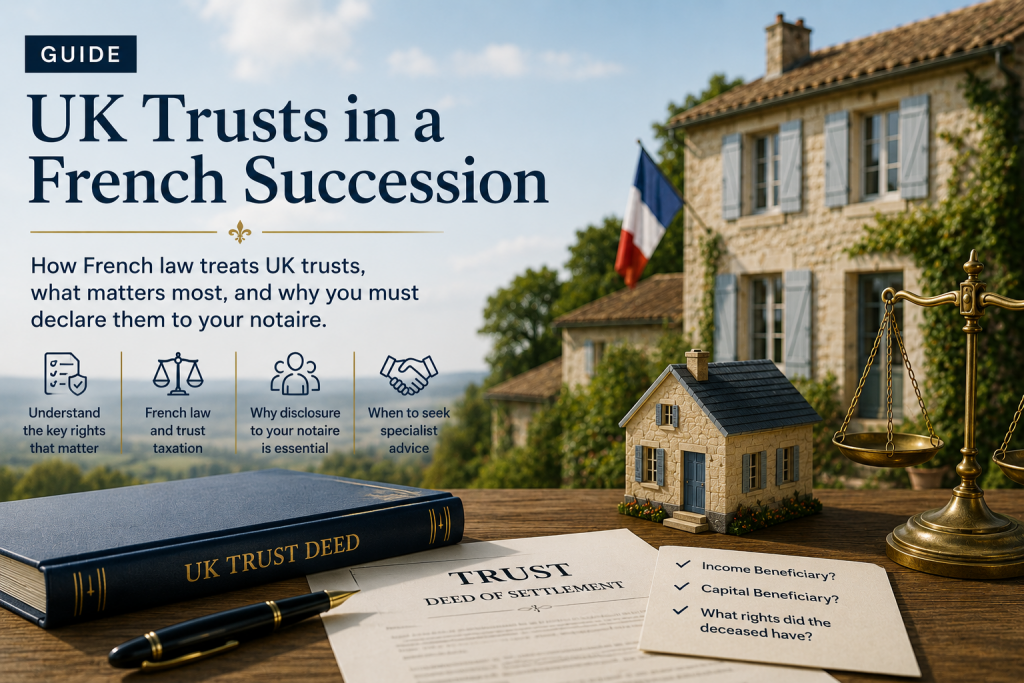
UK trusts can create additional challenges during a French succession. This guide explains how French notaries view trusts, the documents they may request, and practical steps to help demonstrate the trust's structure and beneficiaries.
If the person who died had an interest in a UK trust, it’s understandable to feel a little overwhelmed.
Trusts are common in the UK, particularly where parents or grandparents have tried to protect family assets for future generations. In France, however, trusts are not part of the civil law system in the same way, and their treatment during a succession can be far from straightforward.
One of the biggest misconceptions is that every trust automatically forms part of the deceased’s estate and will therefore be taxed in France.
In reality, that’s rarely a question with a simple yes or no answer.
What matters is what rights the deceased actually had under the trust, and that’s something your French notaire will need to establish before deciding how the trust should be treated.
Always Tell Your Notaire About Any Trusts
Even if you believe the trust has nothing to do with the French succession, you should always tell your notaire that it exists.
Don’t make the decision yourself that a trust isn’t relevant.
Instead, provide your notaire with as much information as possible, including:
- The trust deed (often the will itself, trust deeds typically might not be created and a persons will forming the trust will act as the trust deed, so if they ask for this and it’s merely declared in the will, then explain this to them – check with the original probate solicitor for that will first).
- Any deeds of appointment or amendments.
- Details of the trustees.
- Information explaining the deceased’s interest in the trust.
- Any legal opinion prepared by your UK solicitor.
Your notaire can then decide whether further information is required.
In our own succession, the trusts ultimately weren’t simply ignored—they first had to be understood. Our notaire requested further documentation explaining exactly how the trusts operated under UK law before reaching a conclusion.
Being open from the outset helps avoid delays later and ensures the succession is based on a full understanding of the estate.
Not Every Trust Is Treated the Same
One reason trusts can be so confusing is that there isn’t just one type.
Two trusts might appear very similar at first glance, yet have completely different legal consequences.
French law contains specific provisions dealing with trusts for tax purposes, particularly under Article 792-0 bis of the French General Tax Code, but how those rules apply depends on the particular trust and, most importantly, the rights held by the deceased.
Rather than looking only at what the trust is called, the French authorities will usually want to understand how it actually operates.
The Question That Really Matters
When discussing a trust with your solicitor or notaire, one question is likely to be more important than any other:
Did the deceased have rights to the trust capital, or were they only entitled to receive income?
This distinction can fundamentally change how the trust is viewed during the French succession.
Understanding the Difference
An Income Beneficiary
Many trusts allow someone to benefit from the income generated by the trust without ever owning the underlying assets.
For example, they might receive:
- Rental income from trust property.
- Dividends from investments.
- Interest from savings.
However, they may have no right to:
- Sell trust property.
- Withdraw trust capital.
- Give away trust assets.
- Decide who ultimately inherits the capital.
In many life interest trusts, the deceased enjoys the income during their lifetime while the trust capital belongs to someone else.
A Capital Beneficiary
A capital beneficiary is different.
Depending on the terms of the trust, they may ultimately become entitled to the trust assets themselves or have rights over the trust capital.
Those rights might include:
- Receiving trust assets outright.
- Selling trust property.
- Receiving the proceeds of sale.
- Benefiting directly from the trust capital.
Where these types of rights exist, the French tax analysis becomes considerably more complex.
Why This Matters
French inheritance tax isn’t simply concerned with whether someone was named in a trust.
Instead, it looks at the legal rights the deceased actually held.
If the deceased only had a genuine right to income and never became entitled to the underlying trust capital, there may be strong grounds for arguing that the trust assets themselves do not form part of their taxable estate.
On the other hand, where the deceased had rights over the capital, the trust may be treated very differently.
Every trust has to be considered on its own facts, which is why there is no universal answer that applies to every family.
Our Experience
Our father’s estate included trusts created by our grandparents.
Initially, the existence of those trusts caused considerable uncertainty because the French notaire quite rightly wanted to understand exactly how they worked.
The key point was that our father never owned the trust capital.
He was entitled only to receive income generated by the trusts during his lifetime. The capital itself belonged to the beneficiaries identified under the trust and was never his to sell, distribute or spend.
To explain this, our UK solicitor prepared a detailed legal opinion setting out:
- how the trusts operated;
- what rights our father had;
- what rights he did not have; and
- who actually owned the trust capital.
That legal opinion was then provided to the French notaire to assist with the succession.
Why Choosing the Right Notaire Matters
This is one area where experience really matters.
Many French notaires deal almost entirely with domestic French estates.
Cross-border estates involving UK trusts are much less common, and English trust law has no direct equivalent under French civil law.
An experienced notaire will usually want to understand:
- Who created the trust?
- Who are the trustees?
- Who owns the trust assets?
- Who receives the income?
- Who owns the capital?
- What rights did the deceased actually have?
These are exactly the right questions to ask because they allow the trust to be analysed properly rather than relying on assumptions.
Don’t Be Afraid to Seek Independent Advice
If substantial trust assets are involved, or you don’t fully understand the advice you’ve received, it may also be worth speaking to an avocat with experience in Anglo-French succession law.
This isn’t about disagreeing with your notaire.
It’s about ensuring that a complex area of law has been fully considered before inheritance tax is calculated or important decisions are made.
In many cross-border estates, the best outcome comes from the UK solicitor, the French notaire and, where appropriate, a specialist avocat working together.
The Key Takeaway
The existence of a UK trust doesn’t automatically mean that French inheritance tax will be payable on the trust assets.
Equally, it doesn’t mean the trust can simply be ignored.
Always declare the trust to your notaire, provide the relevant documentation, and let them assess its significance. If additional explanation is needed, your UK solicitor can often prepare a legal opinion explaining how the trust operates under UK law and what rights the deceased actually held.
In many cases, the question isn’t whether a trust exists—it’s whether the deceased ever had rights to the trust capital.
That distinction can make all the difference, and it’s one of the reasons why choosing professionals experienced in both UK trusts and French succession law is so important.